


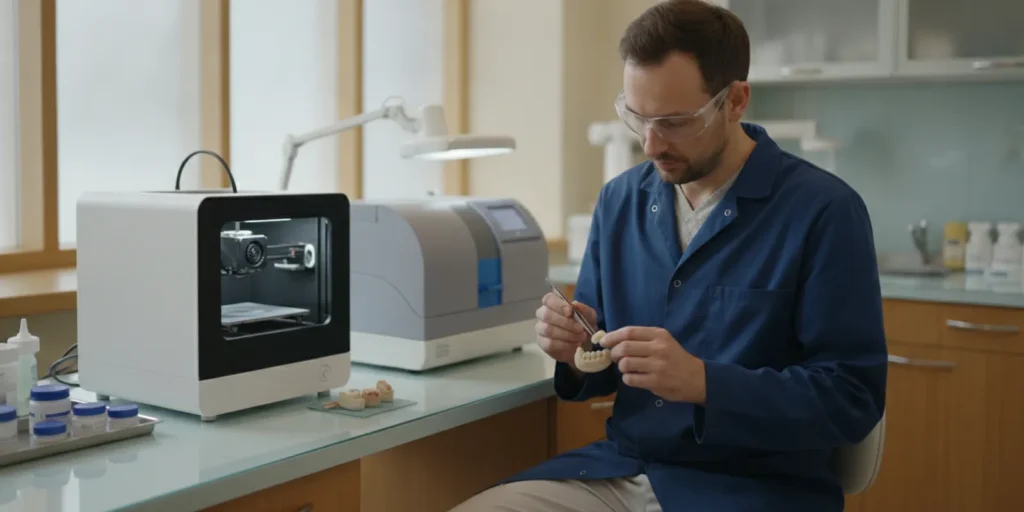
When comparing complex restorative care, patients may encounter the phrase in house dental lab and wonder what it changes. The important difference is not a machine by itself. It is how the dental team coordinates digital records, restoration design, fabrication, and clinical planning around the needs of an individual case. Understanding that workflow can help you ask more useful questions before choosing care.
What does an in-house dental lab do?
A dental laboratory makes restorations and appliances based on information from the dental team. Depending on the case, that work may include designing and fabricating crowns, veneers, implant restorations, or dentures. An in-house lab is located within the practice rather than operating as a separate, outside laboratory. At Dr. Clark’s Roseville practice, restorations are fabricated in the in-house lab, which uses digital technology that includes CAD/CAM systems, 3D printing, five-axis CNC milling, and intraoral scanning.
CAD/CAM means computer-aided design and computer-aided manufacturing. In broad terms, a digital file can be used to design a restoration and guide its manufacture. A scanner captures a digital representation of relevant oral structures; a clinician and lab team then work from that record when planning and making a custom restoration. The exact steps depend on the restoration and clinical situation. Digital equipment is a set of tools, not a substitute for diagnosis, specialist judgment, or communication between the patient and care team.
In-house production can make it easier for the restorative dentist and laboratory team to communicate directly about a case. For complex care, that connection matters because a restoration must be considered in context: the remaining teeth, bite, appearance goals, oral function, and the broader treatment plan. The lab’s role is to help translate that plan into a custom device or restoration; it does not determine by itself which option is appropriate.
It can help to think of the laboratory as a bridge between a clinical plan and the physical restoration. The clinician evaluates the patient and defines the purpose of the restoration. The design and fabrication process turns that plan into a custom object. The finished work is then reviewed in the context of the mouth and the patient’s needs. If an important detail changes during planning, clear communication between the clinical and lab teams can help them discuss how that affects the design or next step.
How do scanning, CAD/CAM, 3D printing, and milling differ?
These terms describe related but distinct parts of a digital workflow. A scan creates a digital record. CAD is used to design. CAM directs manufacturing. Additive manufacturing, such as 3D printing, builds an object in layers. Milling is subtractive: a machine shapes a restoration from a block or other material. A practice may use more than one method, depending on the work being made and the clinical plan.
| Tool or step | What it does | What a patient should understand |
|---|---|---|
| Intraoral scanning | Creates a digital record of relevant oral structures. | The scan is information for assessment and design; it does not by itself establish a diagnosis or final design. |
| CAD | Lets the dental team design a restoration using digital information. | Design decisions still depend on clinical evaluation, material considerations, and the treatment plan. |
| 3D printing | Builds selected dental models or components layer by layer. | Its use depends on the intended item and workflow; not every restoration is made by printing. |
| Five-axis milling | Shapes a restoration or component from a material blank using a controlled cutting process. | The material, design, fit, and finishing steps remain important alongside the machine. |
| Lab finishing and review | Refines and checks the fabricated work before it is used clinically. | Human review and coordination remain part of custom fabrication. |
The practice’s in-house laboratory combines these digital capabilities with hands-on design and finishing. A machine can reproduce a digital design, but it cannot replace the clinical decisions that shape that design or the skilled work needed to review it.
The sequence is not necessarily a single straight line. A team may need to review a scan, confirm what information is available, and consider whether additional records or a different approach are needed. The design is created to fit the clinical plan and selected material. Manufacturing then follows the design, while finishing and evaluation make sure the work is ready for its intended role. If the plan or records change, the team may need to revisit earlier steps. That is one reason it is useful to ask how a particular restoration will be planned rather than assuming that the equipment alone determines the process.
Scanning can be an alternative to traditional impression materials in workflows where a digital impression is suitable. It does not mean that every patient or every procedure uses the same records. The clinician decides what information is needed for the case and explains the purpose of each step. A patient can ask whether a scan is being used for diagnosis, design, or another part of the workflow, and what additional evaluation may be needed.
What can in-house production change for a patient?
The clearest potential advantage is coordination. When the clinician and lab team can discuss a restoration directly, they can address design questions within the same practice. This can support case-specific customization and oversight through fabrication. It may also make it easier to review details or refine a design as part of the planned process. These are workflow advantages, not a promise that every restoration will fit, feel, or look a certain way.
Digital records can also change how information is captured. Intraoral scanning provides a digital alternative to traditional impression materials in workflows where scanning is suitable. Whether a scan is appropriate, and what records are needed, depends on the restoration and patient circumstances. It is reasonable to ask what information will be collected and how it will be used in planning.
Communication can be especially relevant when a case involves several restorations or multiple treatment stages. A design decision for one tooth or prosthesis may need to be considered alongside the bite, neighboring teeth, appearance goals, and other parts of the plan. Direct discussion between the restorative clinician and lab team can help put a technical question in that broader context. It does not eliminate the need to explain the plan to the patient or to consider alternatives.
There is published research on digital dental manufacturing, but its findings should be interpreted in context. A review discussing dental 3D printing describes a study in which patients reported that CAD/CAM dentures were more comfortable, more aesthetic, better fitted, and allowed improved eating and speaking. That report concerns patient perceptions in a particular study; it does not predict an individual’s experience or establish that every digitally made denture performs the same way. Read the review of dental 3D printing.
For custom restorative work, the lab is one element of a larger care process. At this practice, Dr. Jefferson Clark is a board-certified prosthodontist (FACP), and the practice describes a multi-visit consultation model. That gives time for examination, education, discussion of options, and planning before treatment moves forward. Learn more about why patients may consult a prosthodontist for complex restorative needs.
A useful way to evaluate the lab is to ask how it supports the goals of the care plan. Does the proposed restoration address a functional concern, help restore a tooth, or form part of a broader rehabilitation? How will its design relate to the surrounding teeth and bite? What will be reviewed before it is considered complete? Those questions focus the discussion on your situation rather than on a list of devices.
How does the lab fit different restorative options?
A custom lab workflow may be relevant to several kinds of care, but the restoration and the manufacturing method are not interchangeable. The clinical question comes first: what needs to be restored, what structures are involved, and what options merit discussion? The lab then contributes to creating the custom piece selected within the treatment plan.
- Crowns and other tooth restorations: A crown or related restoration is designed for a particular tooth and situation. The practice’s information about procedures to save natural teeth provides context for options that may preserve and restore existing teeth. The restorative plan considers the condition of the tooth and how the proposed work fits its role. A lab can fabricate the planned restoration, but it cannot decide from a scan alone whether a tooth should be restored or what treatment is appropriate.
- Veneers: A veneer is a custom restoration used in selected cosmetic and restorative plans. Design involves considerations such as the tooth, planned appearance, and surrounding smile. The lab’s role is to fabricate the planned restoration; it does not decide whether veneers are suitable. See the practice’s veneers information. Patients can ask how their goals and tooth condition are incorporated into the proposed design, and what other options have been considered.
- Implant restorations: The implant and the visible tooth replacement are distinct parts of an overall process. The restoration must be planned in relation to implant position and the surrounding oral structures. A patient exploring this area can review the practice’s dental implant procedure overview and options for restoring lost teeth. The lab’s role in making the restoration is only one stage; evaluation, implant planning, and any healing interval are separate considerations.
- Dentures: Digital design and fabrication may be used in some denture workflows. The design must still account for each person’s anatomy, comfort, function, and clinical needs. Explore what digital dentures are for more background. A patient may ask which parts of the process are digital, how the team will assess the finished denture, and what follow-up may be part of the plan.
These examples are not a recommendation for any particular treatment. A thorough evaluation helps determine what concerns are present and which options can be discussed. A digital lab is most useful when its work supports a clearly explained, individualized plan rather than serving as the reason to select a procedure.
The practice emphasizes saving natural teeth when that is clinically appropriate, with health considered before function and appearance. That order is important when comparing custom restorations. A technically sophisticated way to make a restoration does not, by itself, make that restoration the best choice. Patients can ask whether preserving existing tooth structure is relevant, what the proposed restoration is intended to accomplish, and what the alternatives mean for the overall plan.
Does an in-house lab make treatment faster?
It is tempting to assume that an on-site lab means every restoration can be completed in fewer appointments. That is not a safe assumption. Overall timing depends on the type of restoration, the steps needed before fabrication, healing where relevant, clinical checks, and how the case is progressing. Some complex plans involve several visits even when the lab is in the same building.
For example, implant treatment includes stages beyond making the final restoration. The practice’s general information notes that implant integration can take three to six months; bone grafting, when part of a plan, may require three to six months of healing before implant placement. These timelines are not universal schedules for every patient. The clinician can explain which stages apply to a particular case and how they affect the overall sequence.
An in-house lab may support communication and control over fabrication steps, but it does not remove the need for examination, healing time, or follow-up. Ask for a sequence of visits and the purpose of each stage, rather than judging a plan only by how quickly a device can be made.
To make a timing discussion concrete, ask the team to separate the plan into stages. What happens during evaluation and record-taking? When is a design made and reviewed? Is there a temporary restoration or a healing interval? When will the final restoration be assessed, and might an adjustment or additional review be needed? The answers can help distinguish fabrication time from the full clinical timeline. They also help you understand which parts of the schedule depend on healing or your individual response, rather than on lab capacity.
How should you compare a practice’s lab and restoration process?
When you compare providers, ask how the lab’s work connects to diagnosis and planning. The existence of advanced equipment alone does not tell you how the practice evaluates a case, checks a restoration, or discusses alternatives. Useful questions include:
- Which parts of my proposed restoration are designed or fabricated in the in-house lab, and which parts involve other facilities?
- How does the prosthodontist work with the lab team when a design question comes up?
- What materials and restoration options are being considered, and why are they relevant to my situation?
- What records, scans, or imaging are part of the evaluation, and what can each one show?
- What are the expected stages and visits, including any healing periods or review appointments?
- How will fit, function, and appearance be assessed before the restoration is considered complete?
- What alternatives should I understand, including the option of preserving natural tooth structure when that is relevant?
- What is included in the written estimate, and what could change the plan or its cost?
You can also ask who will explain the design and how to raise a concern if the proposed plan does not seem clear. A good discussion should translate technical terms into practical meaning: what is being made, what it is intended to do, how it fits with the rest of treatment, and what uncertainties remain. If the proposal includes several restorations, ask how their sequence relates to one another and whether the plan may change after an earlier stage is assessed.
Clear answers should connect the technology to your specific goals and clinical findings. They should also make room for questions. The practice’s private-care model is out of network with all insurance; patients can ask the office for current financial information and a written explanation of proposed care. The purpose of a consultation is to understand the situation and options, not to make a decision based on equipment or marketing language alone.
When reviewing a written plan, look for more than a final device name. You may want to understand the purpose of each proposed step, the sequence, what is included in the fee estimate, and which factors could lead to a change. The practice’s new patient resources can help you learn what to expect when preparing for an evaluation. The office can clarify current financial details and how the private-care model applies to your case.
What should you expect from a consultation with a prosthodontist?
A consultation for complex restorative care is a chance to understand the current condition and discuss a thoughtful plan. The practice describes a staged process that includes reviewing dental and medical history, examination and diagnostic records, education about findings and options, and treatment planning with realistic expectations. The number and order of visits depend on the individual situation.
This multi-visit process gives time to understand the findings and consider how health, function, and appearance relate to one another. A consultation is not simply a lab appointment or a decision about which machine will be used. It is an opportunity to discuss what needs attention, what can be preserved, which restorative choices may be relevant, and how each choice fits the larger picture. When a custom restoration is part of the plan, the team can explain how the lab contributes to the design and fabrication stages.
Bring your questions about priorities, function, appearance, timing, materials, maintenance, and cost. If you have prior dental records or specific concerns, ask the office how to share them. You should leave understanding what the proposed steps are intended to address, what uncertainties remain, and what alternatives have been discussed. A well-equipped lab can support the technical work, while the clinical conversation helps put that work into context.
For readers in Roseville, Rocklin, Granite Bay, Folsom, and the Sacramento area, Dr. Clark’s practice focuses on prosthodontic and restorative care. Learn more about the practice and its approach on the practice overview page.
Frequently Asked Questions
Is an in-house dental lab the same as a dental office with a 3D printer?
No. A printer is one possible piece of equipment. A lab workflow can include scanning, digital design, milling, printing, finishing, and communication between the clinician and lab team. The equipment and steps used depend on the work being made.
Does digital fabrication guarantee a better fit?
No fabrication method can guarantee an individual outcome. Digital tools can support design and production, but fit and function also depend on clinical records, planning, material, fabrication, and evaluation. Ask how the practice checks the restoration and what follow-up is part of the plan.
Are all crowns, dentures, and veneers made with 3D printing?
No. Dental restorations can involve different materials and manufacturing methods. Some items may be printed, while others may be milled or fabricated through another process. The team can explain which method applies to the proposed restoration.
Will an in-house lab reduce the number of visits?
Not necessarily. The number of appointments depends on the treatment plan and clinical needs. Healing periods, preparation, review, and adjustments may affect timing even when a lab is on-site.
What is the most useful question to ask about the lab?
Ask how the lab’s work fits into the clinical plan for your case, and how the clinician and lab team review the design and finished restoration. That answer is more informative than a machine list alone.
An in-house dental lab can bring restoration design and fabrication closer to the clinical team, but technology is only one part of careful restorative care. A consultation with a prosthodontist can help clarify the findings, options, timing, and questions that matter for your own situation.