


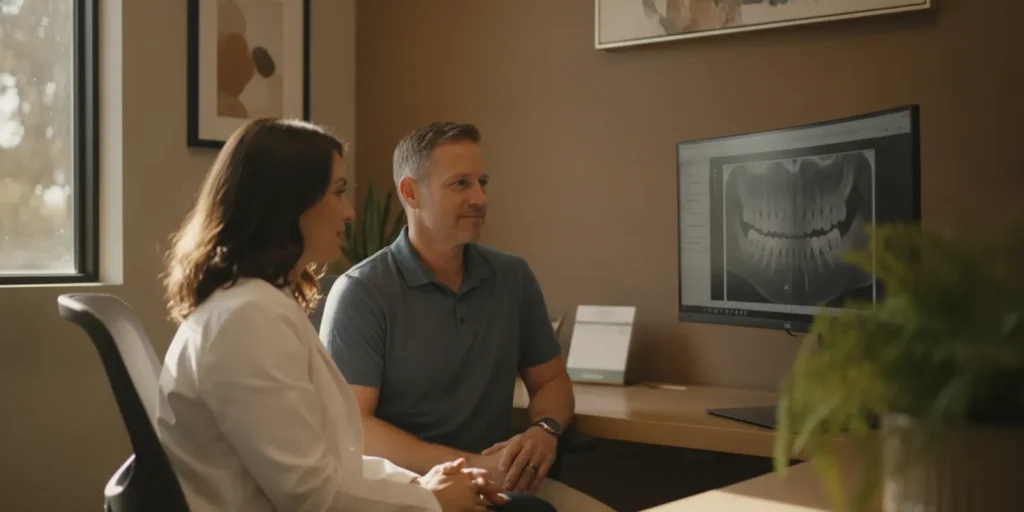
When several teeth are worn, damaged, missing, or supported by dental work that needs attention, understanding the full mouth reconstruction cost and process takes more than looking for a single price. A plan may involve different restorative procedures, and the right sequence depends on a careful evaluation of oral health. Function, and the condition of the teeth and supporting structures. This guide explains how specialist planning works, what can affect cost and timing, and how to prepare for a useful consultation.
What does full mouth reconstruction mean?
Full mouth reconstruction, also called full mouth rehabilitation, is a coordinated approach to restoring oral health and function when multiple dental concerns need to be considered together. It is not one standard procedure or a package with the same steps for every person. A plan may combine restorative treatments such as crowns, bridges, implants, or dentures, depending on the findings and the patient’s goals.
The central question is not simply which teeth should be restored. A prosthodontist considers how the teeth work together, the condition of existing restorations. The health of the gums and supporting bone, and factors that may contribute to ongoing wear or damage. That broader view helps the clinician plan around causes and long-term function, not just an isolated symptom.
At Dr. Jefferson Clark’s practice, care is led by a board-certified prosthodontist (FACP), a specialist in complex tooth replacement and restoration. A comprehensive plan is developed through a multi-visit consultation process. The goal is to understand the whole picture, explain possible approaches, and make decisions with the patient rather than rush into a predetermined treatment.
That planning also helps distinguish the overall rehabilitation from the individual procedures that may appear in an estimate. A crown, bridge, implant restoration, or denture is one component; the reconstruction plan considers how selected components relate to one another. For example, decisions about the shape and position of a restoration may need to account for the bite and the neighboring teeth. The exact relationship varies by case, so the plan should explain not only what is proposed but why the parts are being coordinated.
Who may need a full mouth reconstruction evaluation?
A person may want an evaluation when several areas of the mouth have problems that appear connected or need coordinated care. Examples can include multiple teeth that are worn down, broken, decayed, or missing. Older dental work that needs repair; or a bite and restorative situation that requires more than one procedure to address. These examples are reasons to discuss concerns with a qualified dental professional, not a way to diagnose yourself.
Some people have had dental work over many years and now face several decisions at once. Others may have experienced tooth loss or damage and want to understand how different restorative options fit together. An evaluation can help clarify which concerns are urgent, which options may be appropriate to discuss, and whether a comprehensive plan is useful. A single symptom or a certain number of affected teeth does not, by itself, determine the need for reconstruction.
It can help to distinguish a full mouth reconstruction discussion from a request focused only on appearance. Cosmetic goals may be part of a plan, but health and function come first. A careful assessment may consider the condition of natural teeth and existing work before discussing the final appearance of restorations. This reflects a simple sequence: health first, then function, then beauty.
For an overview of how specialist training differs, see why someone may see a prosthodontist. Patients with missing teeth can also review the practice’s options for restoring lost teeth as background before a conversation.
How does full mouth reconstruction cost and process vary by case?
There is no responsible way to quote one universal total for full mouth reconstruction. The estimate must reflect what the examination and diagnostic records show. How many teeth or supporting structures require attention, which procedures are appropriate, and how the stages need to be sequenced. Two people may use the same treatment label while needing very different care.
A useful estimate separates clinical findings from the proposed response. The plan may account for preparation, restorative procedures, temporary and final restorations where applicable, custom laboratory work, appointments, healing intervals, and follow-up. Materials also matter, but material selection should follow the functional and clinical requirements of the case rather than a generic package.
| Planning factor | What it may include | Why it affects the estimate |
|---|---|---|
| Current condition | Natural teeth, existing restorations, gums, bite, and supporting structures | The scope depends on the number and complexity of concerns that need attention. |
| Restorative approach | Crowns, bridges, implants, dentures, or other appropriate restorations | Each option involves different procedures, materials, laboratory work, and follow-up. |
| Preparation and sequence | Preparatory care and the order in which treatment stages are completed | Some steps need to occur before later restorations can be planned or placed. |
| Custom laboratory work | Digital design, fabrication, fit, and refinement of restorations | The type, number, and customization of restorations shape the plan. |
| Time and follow-up | Consultations, treatment visits, healing periods, and review appointments | Staged care may require multiple visits and reassessment between steps. |
This table describes the questions behind an estimate, not a reconstruction package or a list of procedures every patient needs. The practice’s in-house laboratory uses CAD/CAM, 3D printing, and 5-axis milling for customized restorations. When crowns are part of a plan, the approved range is $1,200-$2,500 per tooth. That is a procedure-specific range, not a full-case total. For a separate discussion of implant-related fees, review dental implant cost information.
Complex restorative care begins with comprehensive examination and diagnosis. A peer-reviewed case report on full-mouth rehabilitation describes the need for a comprehensive examination, diagnosis, and treatment-planning strategy that considers patient needs and expectations. Read the peer-reviewed case report on comprehensive rehabilitation planning for context. This reinforces why an estimate should follow clinical findings rather than precede them.
After the findings are reviewed, a multi-visit consultation can clarify what each proposed stage is meant to address. Which alternatives are reasonable to discuss, and what may prompt reassessment. Digital scans, imaging, visualization, 3D implant planning, and digital wax-ups may be used when appropriate. This process helps connect the estimate to the diagnosis instead of presenting a disconnected list of fees.
The practice provides private-care, out-of-network treatment and does not participate with insurance companies. Patients should understand that financial arrangement before choosing care and should not assume that an insurance plan will be billed or that a particular benefit will apply. Ask how fees are organized, what is included at each stage, and how changes would be discussed if clinical findings or healing affect the sequence.
What happens during the reconstruction planning process?
Comprehensive care begins with understanding the patient’s concerns and gathering information. Rather than make decisions from a quick visual impression alone, a specialist evaluation considers dental and medical history, examination findings, and appropriate imaging. The exact records needed depend on the case.
1. Share your concerns and priorities
At the start, explain what is bothering you, what dental work you have had, and what you hope to improve. Useful topics include chewing or comfort concerns, restorations that have needed repeated attention, teeth that have changed over time, and the outcomes that matter most to you. Bring a list of questions and any relevant information about previous dental treatment. The purpose is to give the clinician context, not to arrive with a self-diagnosis or a preferred procedure that must be used.
It may be helpful to organize concerns before the visit. Write down which areas have required attention, when previous dental work was completed if you know, and what you would most like to understand. Separate immediate questions from longer-term goals. For instance, you might want to ask first what is driving repeated repairs, then ask how different restoration choices could affect function and appearance. This simple preparation can make a complex discussion easier to follow without assuming what treatment is needed.
2. Complete a specialist evaluation
The clinician reviews the history, examines the mouth, and may obtain diagnostic images or other records needed to understand the situation. The evaluation looks beyond the most visible tooth. It can include the condition of existing dental work and how the teeth and bite function together. If a concern needs further assessment, that should be explained as part of the planning conversation.
Information gathering is important because a symptom may not show the full scope of a restorative concern. A tooth that appears to be the main issue may be considered alongside nearby teeth, existing restorations, or the way the bite comes together. The purpose is not to add procedures automatically. It is to make sure the discussion is based on the broader findings and to identify where there is enough information to make a plan and where further assessment may be needed.
3. Review findings and possible approaches
Once the findings are understood, the prosthodontist can explain the concerns, the goals of care, and possible restorative approaches. A plan may include more than one type of treatment, but not every option is appropriate in every case. Ask what each proposed step is meant to accomplish, what alternatives exist, and what tradeoffs to consider. This is also the time to make sure the plan addresses health and function before cosmetic priorities.
When a natural tooth is part of the discussion, ask whether preserving it is a reasonable possibility to consider and what findings inform that conversation. When a tooth is missing, ask how the proposed replacement relates to the surrounding teeth and the overall plan. These questions encourage an explanation of the clinical reasoning rather than a choice based only on a procedure label. A specialist should be able to describe what each option is intended to do and why another approach might or might not fit the findings.
4. Discuss sequence, timing, and fees
Complex restorative care is often staged. The sequence depends on the findings and the procedures being considered. Some treatments have healing periods before later work can proceed. For example, when bone grafting is part of implant preparation, the stated healing period before implant placement is 3-6 months. Implant integration also takes time; the practice’s stated range is 3-6 months. These are general ranges, not a promise of a specific schedule for an individual.
In the planning conversation, review what is expected at each stage. How the provisional and final restorations fit into the plan where applicable, and when progress will be reassessed. Ask for costs associated with the proposed stages and what could cause the plan to change. A multi-visit process allows time for questions and individualized planning. It should not be presented as a same-day solution for every complex case.
A practical way to understand timing is to request a sequence in plain language: what is planned first. What needs to happen before the next stage, and what will determine readiness to proceed. When healing is involved, ask how the practice will review progress and whether the next step depends on that review. The schedule should reflect the procedures actually being considered, not a generic timeline copied from another person’s experience.
Patients can also ask which visits are intended for planning, which involve treatment, and when restoration design or fit will be reviewed. That distinction can help with arranging time and understanding why a multi-visit process may be appropriate. It is reasonable to confirm that the proposed schedule accounts for both clinical stages and the time needed to discuss decisions. A thorough process gives the patient opportunities to ask questions as the plan develops.
5. Make an informed decision
You should have the chance to understand the proposed care before deciding whether to proceed. Consider whether the plan addresses your stated priorities, whether the sequence is clear, and whether you understand the expected time commitment and financial arrangement. If any part is unclear, ask for it to be explained in plain language. Taking time to compare the reasoning behind options can be more useful than choosing based on a procedure name alone.
Before you decide, you can summarize the plan back in your own words: the main concern. The proposed stages, the reason for the order, and the questions that remain. This is a useful check for both patient and clinician. If a term or fee is unfamiliar, pause on that item rather than relying on an assumption. Decisions about comprehensive care involve multiple connected details, and understanding them is more important than moving through a checklist quickly.
Dr. Clark’s practice uses a multi-visit consultation model and has an in-house dental laboratory with digital design and fabrication capabilities, including CAD/CAM, 3D printing, and 5-axis milling. When custom restorations are discussed, coordination between the clinician and laboratory can be part of planning and fabrication. Learn more about the in-house dental laboratory and the practice’s private-care approach.
How do restorative options fit into a plan?
The options considered depend on what the evaluation shows. A crown may be discussed to restore a damaged tooth. A bridge or implant-supported restoration may be considered when teeth are missing. Dentures, including implant-supported options, may be part of a conversation about replacing multiple teeth. These are broad examples of treatment categories, not recommendations for a particular reader.
When natural teeth can be preserved, that possibility belongs in the discussion. The condition of each tooth and its supporting structures matters; replacement is not automatically the starting point. In other situations, a tooth may not be restorable, or a missing tooth may need to be addressed as part of a larger plan. A specialist can explain the reasoning behind each proposed choice and whether there are alternatives.
The design of restorations matters as much as their category. The bite, appearance, material, and relationship to other teeth all affect how a restoration is planned. An in-house lab can support direct collaboration on custom restorations, but the presence of a laboratory does not mean every case has the same design or timeline. Ask how the proposed restoration will be designed for your specific needs and what review or refinement is expected.
For a useful comparison, ask the clinician to describe each option in terms of its purpose. What it involves, how it fits the overall plan, and what limitations or tradeoffs are relevant to your findings. A bridge, an implant-supported restoration, and a denture are not interchangeable labels for identical care. Their suitability depends on individual circumstances. The goal of comparison is to understand the choices that are actually appropriate to discuss, not to rank treatments in the abstract.
Custom restoration planning may include design decisions about shape, fit, and how the restoration relates to other teeth. The practice’s in-house laboratory supports coordination on that work. Ask what input or review occurs during fabrication, what the patient should expect at fit or adjustment visits. And how the clinician will assess the restoration in the context of the plan. Those details can make the process more understandable without implying a particular result.
If implants are among the topics you want to understand, review the practice’s overview of the dental implant procedure. Use it as general background, then ask how the information applies to your own findings rather than assuming that a general description predicts your treatment.
How can you compare treatment plans and estimates?
If you are reviewing more than one proposed plan, start by identifying the concerns each plan addresses. Do not compare totals until you know whether the scope is similar. One plan may address a broader set of findings or include different stages, while another may focus on a narrower goal. Ask the clinicians to clarify the rationale, alternatives, and what is included so you can make a meaningful comparison.
A short comparison sheet can help. For each proposed approach, note the goal, the procedures listed, the order of care, expected visits or healing intervals, and the fees associated with each stage. Leave space for questions such as whether temporary restorations are part of the plan when relevant, what follow-up is expected, and what could lead to reassessment. Do not assume that an item is included or excluded based on a brief label; ask the office to explain the written estimate.
Also consider whether the plan responds to your priorities. If preserving natural teeth is important to you, ask how that goal was considered. If appearance is a concern, ask how it fits after health and function have been assessed. A useful plan should connect the proposed procedures to the findings and goals, rather than present a list without explanation. It is acceptable to take time to read the plan and return with questions.
What questions should you bring to a consultation?
A focused list can help you use consultation time well. Consider asking:
- What are the main findings from my evaluation?
- Which concerns should the plan address first, and why?
- Is preserving any natural tooth a reasonable option to discuss?
- What restorative approaches are being considered, and what are their tradeoffs?
- What is the purpose of each proposed stage?
- What is the expected sequence, and are there healing periods between stages?
- Which parts of the plan are included in the written estimate?
- What could change the scope, timing, or fees?
- How are custom restorations designed and evaluated?
- What does the practice’s out-of-network, private-care model mean for billing and payment?
It is reasonable to ask for explanations more than once. Complex care can involve unfamiliar terms, and clarity is part of making an informed decision. If you are comparing plans, compare what each plan is intended to address, how the proposed sequence works, and what is included, not only the treatment labels.
Before the meeting, choose the two or three questions that matter most to you in case time is limited. During the discussion, take notes on unfamiliar terms and ask for the plan to be summarized in writing. Afterward, review the estimate alongside those notes. This gives you a concrete way to identify unanswered questions rather than trying to remember every detail of a technical conversation.
Schedule a consultation to discuss your restorative needs
Frequently Asked Questions
Is there one standard price for full mouth reconstruction?
No. Full mouth reconstruction describes a coordinated plan, not one standard procedure. The estimate depends on the findings, the restorative options considered, the number of procedures, and the sequence. A clinician needs to evaluate the individual situation before discussing a case-specific plan and fees.
Does full mouth reconstruction always include dental implants?
No. Implants are one possible restorative option, but they are not required in every reconstruction plan. The options depend on the condition of natural teeth, the number and location of missing teeth, supporting structures, and the patient’s circumstances. A prosthodontist can explain which approaches are appropriate to consider after an evaluation.
How long does the process take?
Timing varies with the plan and the procedures involved. Comprehensive care may require multiple visits and, when applicable, healing time between stages. Bone grafting before implant placement generally requires 3-6 months of healing, and implant integration takes 3-6 months. These ranges are not a personal timeline or a guarantee; the clinician can explain what may apply to your plan.
Will insurance cover full mouth reconstruction at Dr. Clark’s practice?
The practice is out of network with all insurance and does not participate with insurance companies. Ask the office to explain the practice’s fees and private-care arrangements. Do not assume that insurance will be billed or that coverage applies.
Can I know which treatment I need before an evaluation?
General information can help you prepare, but it cannot determine which procedures are appropriate for you. A specialist evaluates the condition of the teeth, restorations, gums, bite, and supporting structures before explaining possible approaches. Bring your questions and concerns so the discussion can focus on your situation.
Schedule a consultation with Dr. Clark’s office
Understanding the findings, the reasoning behind each step, and the financial arrangement can make a complex restorative decision easier to evaluate at your own pace.