


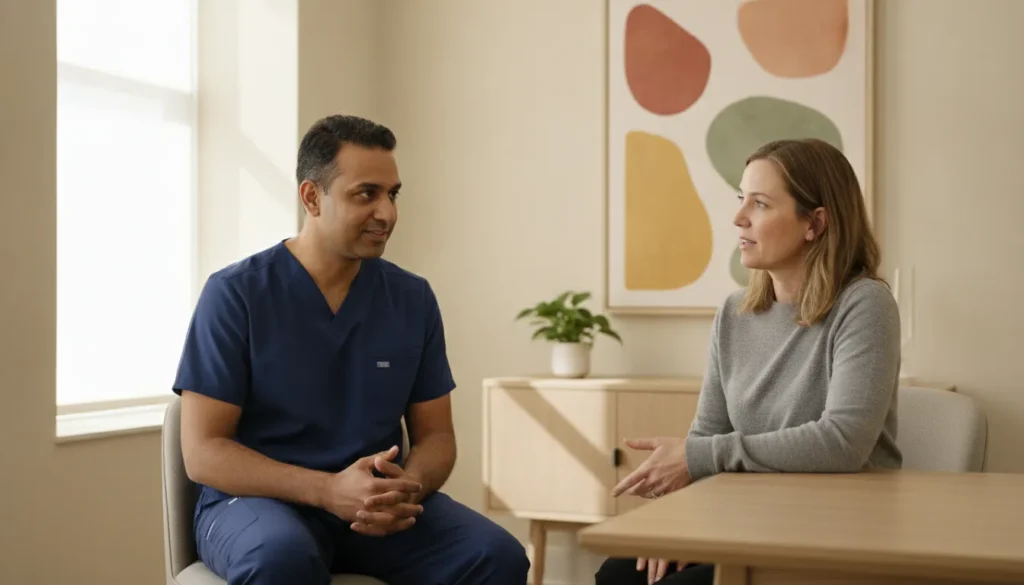
Jaw pain, headaches, clicking, facial discomfort, or limited movement can make ordinary activities feel unexpectedly difficult. These symptoms may involve the jaw joints, chewing muscles, or related pain patterns, and they do not always point to one obvious cause.
For patients comparing a tmj specialist roseville ca, the most useful starting point is a careful evaluation that considers your history, jaw function, muscle tenderness, and any imaging that may be appropriate. TMD is an umbrella term for more than 30 conditions, and a person can have more than one condition at the same time. A specialist-level consultation can help clarify what should be investigated and which options may be reasonable.
Dr. Jefferson Clark’s prosthodontic approach emphasizes whole-person, whole-system planning rather than treating a symptom in isolation. Learn more about TMJ/TMD treatment and functional dentistry, then consider what specialist assessment adds when symptoms persist or interfere with function.
Why TMJ Needs a Specialist, Not a General Dentist
Overlapping conditions require careful clinical reasoning
Jaw pain, headaches, clicking, facial discomfort, and restricted movement can arise from different structures and patterns of dysfunction. Temporomandibular disorders, or TMDs, are not one condition. The National Institute of Dental and Craniofacial Research describes more than 30 conditions involving the jaw joints, chewing muscles, and related headaches. A person may also have more than one TMD condition at the same time. That overlap helps explain why a symptom-based treatment plan may not address the full picture. NIDCR’s TMD overview provides additional clinical context.
There is no single widely accepted test that diagnoses every TMD, and symptoms can resemble problems outside the jaw joints and muscles. Pain in the mouth, jaw, or face may or may not be related to TMD, so a responsible evaluation considers whether other conditions need to be ruled out. The exact cause is also unclear in many cases. Research points to a combination of possible contributors, including life stressors, pain perception, and other health factors. This is why specialist assessment is valuable: it creates space for a detailed history, focused examination, and a measured discussion of what should happen next rather than assuming one cause.
Seeing a specialist does not diminish the important role of a general dentist. General dentists often identify concerning symptoms, provide essential preventive and restorative care, and help coordinate referrals. A prosthodontist brings additional training in oral function, jaw relationships, restorative dentistry, and complex treatment planning. At Dr. Clark’s Roseville practice, a multi-visit consultation can support careful education and individualized planning when symptoms persist or interfere with daily function. The goal is not to label every sound or sensation as disease. Research indicates that painless jaw clicking or popping is common and generally does not require treatment. Likewise, evidence does not support the idea that a “bad bite” or orthodontic treatment causes TMD. A thoughtful clinician avoids both over-treatment and false reassurance.
What a TMJ Specialist in Roseville CA Looks For in an Assessment
A careful assessment is more than checking whether the jaw clicks. Jaw, facial, and mouth pain can have overlapping causes, so the clinician gathers several kinds of information before deciding whether the symptoms fit a temporomandibular disorder or whether another condition should be considered. There is no single, widely accepted test that diagnoses every TMD, so clinical judgment matters.
Your history and symptom pattern
The visit typically begins with questions about when the discomfort started, where it occurs, and what makes it better or worse. The clinician may ask whether symptoms spread into the face, neck, or elsewhere, whether the jaw feels stiff or locks, and whether chewing, talking, waking, or stress changes the pattern. A history of headaches, sleep problems, widespread pain, prior injury, dental treatment, or other pain conditions can also provide useful context. These details help distinguish a brief, isolated symptom from a pattern that warrants closer evaluation. They do not, by themselves, establish a diagnosis.
Jaw movement, muscles, and joint sounds
The examination may include the head, neck, face, and jaw. The clinician may gently press around the jaw and chewing muscles to identify tenderness. The clinician may listen to and feel the joints as the mouth opens and closes, and observe the range and path of movement. Opening limitations, deviation, locking, or pain during movement may be relevant. Clicking or popping without pain is common and does not automatically require treatment. The significance of a sound depends on the broader history and examination, not the sound alone.
Imaging is considered when the clinical picture calls for more information, not as an automatic part of every visit. Depending on the question, dental X-rays, CT, or MRI may be recommended. CT can show bone detail, while MRI can help assess the joint disk and surrounding soft tissue. A specialist may use these findings alongside the examination and history to plan an appropriately measured next step. When appliance therapy is relevant, the discussion may include custom splint therapy options, but the device and design should follow the individual assessment.
Treatment Options Available at Dr. Clark’s Roseville Practice
Treatment planning begins with the least invasive option that fits the clinical findings, symptoms, and goals. Some jaw symptoms settle without treatment, while persistent or function-limiting concerns may call for more than one coordinated approach. Dr. Clark’s practice describes conservative, reversible care as the starting point, with procedures considered only when appropriate.
Conservative TMJ and TMD treatment options
| Option | Purpose | Planning considerations | Coordination or next step |
|---|---|---|---|
| Custom splint or oral appliance | Support jaw function and help manage selected joint or muscle-related concerns. | Design may account for bite, jaw position, muscle function, and treatment goals. Options can include stabilization, repositioning, soft, or anterior bite splints. | Requires individualized assessment and follow-up. See custom splint therapy options. |
| Jaw exercises or physical therapy | Address movement, stretching, strengthening, and muscle function when clinically appropriate. | Exercises should match the person’s findings and tolerance rather than follow a generic routine. | A qualified clinician may recommend or coordinate physical therapy when that adds value to the plan. |
| Habit and lifestyle changes | Reduce contributors such as clenching, gum chewing, nail biting, or other behaviors that overload the jaw. | Changes are selected around the patient’s daily patterns, stressors, and symptoms. Heat or ice may be appropriate for some presentations. | Progress is reviewed alongside symptom changes and jaw function, without assuming one cause. |
| Medication coordination | Support symptom management when medication is medically appropriate. | Medication choice, safety, and dosing belong with the patient’s physician or prescribing clinician. | Dental treatment may be coordinated with medical care rather than replacing it. |
Escalation is not automatic. Irreversible treatment, surgery, or procedures that permanently change teeth, bite, or jaw require a careful discussion of potential benefits, risks, and alternatives. The practice’s options include escalation for appropriate cases, but the right decision depends on the assessment, the suspected contributors, and the patient’s informed goals.
The Root-Cause Difference: Treating the System, Not the Symptom
Jaw discomfort is not always a problem that can be explained by one structure or corrected by changing one feature of the bite. Temporomandibular disorders can involve the joints, the chewing muscles, and related headache patterns, and a person may experience more than one condition at once. The exact cause is often unclear. A thoughtful evaluation therefore looks beyond the location of pain and asks how the jaw, muscles, habits, stress, sleep, and broader health context may interact.
Why muscle and joint contributors matter
Clenching and grinding can be associated with jaw-muscle pain. And pain that feels like it is coming from the joint may sometimes reflect muscle soreness rather than damage within the joint. Other contributors can include life stressors, pain sensitivity, sleep problems, headaches, or conditions involving widespread pain. These factors do not mean symptoms are imagined. They mean the clinical picture deserves careful interpretation rather than a reflexive procedure.
This is also why bite should be considered in context. Research does not support the belief that a “bad bite” or orthodontic treatment causes TMD. A bite assessment may still be relevant to planning for an individual patient. But it should not be presented as proof of the cause or as a reason to make irreversible changes without discussing benefits, risks, and alternatives.
A whole-person plan, not a single correction
Dr. Clark’s approach describes root-cause care from a whole-person, whole-system perspective. That can mean prioritizing conservative, reversible steps while considering muscle function, jaw position, treatment goals, and related health factors. A custom appliance, a referral for physical therapy, habit changes, or other measures may be considered when appropriate, based on the evaluation rather than a preset formula.
Learn more about TMJ/TMD treatment in Roseville and what a prosthodontist does when complex jaw, bite, and restorative questions overlap. The goal is not to promise a specific outcome, but to build a clearer explanation and a measured plan for the individual.
How to Prepare for a TMJ Consultation in Roseville
A thoughtful consultation begins with a clear account of what you have noticed. Before meeting with a TMJ specialist in Roseville, CA, focus on documenting patterns rather than trying to diagnose yourself. A clinician may need to consider jaw movement, muscle tenderness, joint sounds, pain timing, and other factors together.
- Record your symptoms and their patterns. Note where discomfort occurs, when it began, how often it appears, and what seems to make it better or worse. Include headaches, facial discomfort, clicking, limited movement, locking, or pain that spreads. If you notice clenching or grinding, record when it tends to occur. This information can help guide the history portion of the evaluation.
- Bring relevant records and a medication list. Bring prior dental or medical records, imaging reports, appliance history, and a list of current medications or supplements when available. You may also bring questions about previous recommendations, especially if you were advised to consider a treatment that permanently changes the teeth, bite, or jaw.
- Define what you want to understand. Consider whether your main goal is to clarify a diagnosis, understand conservative options, improve comfort during daily function, or determine whether coordination with another provider is appropriate. A goal helps organize the discussion without assuming a particular treatment or result will be right for you.
- Plan for a careful conversation. Dr. Jefferson Clark is a board-certified prosthodontist with DDS, MS, and FACP credentials. His Roseville practice serves patients from Rocklin, Granite Bay, Folsom, and the greater Sacramento area. The office is located at 2350 Professional Dr., Suite 100, Roseville, CA 95661. Published hours are Monday through Wednesday, 8 a.m. to 3 p.m., with Thursday and Friday visits by appointment. Learn more about Dr. Clark’s prosthodontic credentials, then use the contact page to schedule a consultation when you are ready to discuss your concerns.
Frequently Asked Questions
Should I see a specialist for jaw clicking if it does not hurt?
Not necessarily. Clicking or popping without pain or limited movement is common and often does not require treatment. An evaluation becomes more important when sounds occur with pain, locking, restricted movement, or changes in chewing function. The National Institute of Dental and Craniofacial Research explains that painless clicking is generally considered normal.
What happens during a TMJ evaluation?
The clinician may discuss when your symptoms occur, what worsens or relieves them, whether pain spreads, and any related health concerns. The examination may include observing jaw movement, listening for joint sounds, and checking the jaw, face, and neck for tenderness. Imaging such as dental X-rays, CT, or MRI is considered when the clinical findings make it useful.
Will I need a scan or MRI to find the cause of my symptoms?
Not always. There is no single widely accepted standard test for TMD, so diagnosis depends on the history and clinical examination. Imaging may be recommended when more information about the joint, bone, disk, or surrounding soft tissue is needed. Other causes of mouth, jaw, or facial pain may also need to be ruled out.
What treatment is usually considered first?
Care often begins with conservative, reversible measures when appropriate. Depending on the findings, a plan may include habit changes, exercises or physical-therapy coordination, medication coordination, or a custom oral splint. The right sequence depends on the suspected contributors, your symptoms, and your goals. Procedures that permanently change the teeth, bite, or jaw require careful discussion of benefits, risks, and alternatives.
How should I prepare for a consultation in Roseville?
Bring a short symptom history, including when discomfort began, where it occurs, what triggers it, and how it affects eating, sleep, or daily activities. Note prior dental or medical evaluations, appliances, medications, and questions about options. A multi-visit consultation can provide time for education and individualized planning rather than rushing to a treatment decision.
Schedule a TMJ Consultation in Roseville
A focused consultation can help organize your symptoms, concerns, and goals before discussing personalized treatment planning. If you are considering specialist TMJ care, schedule a consultation with Dr. Clark to discuss an evaluation suited to your needs.