


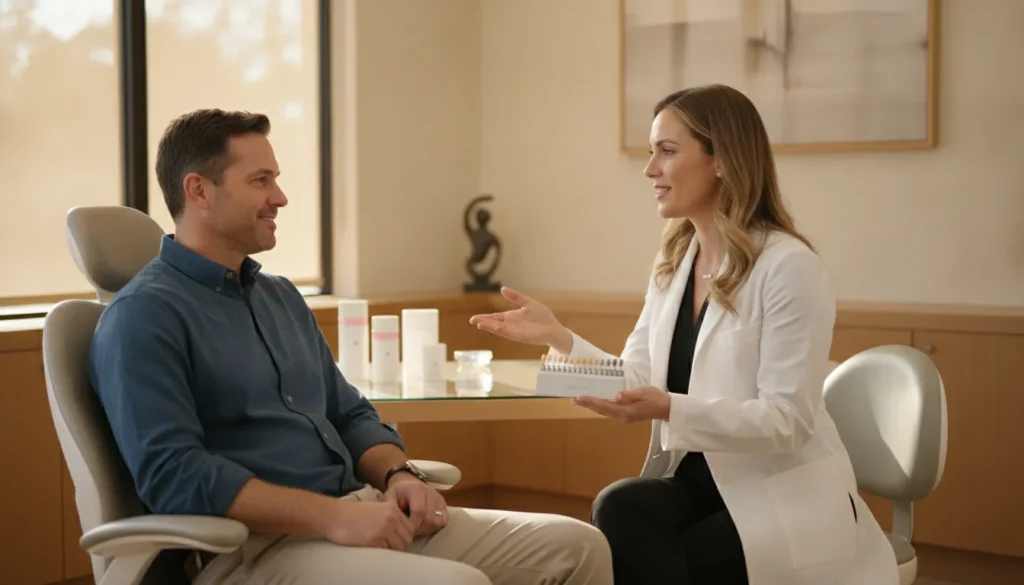
A brighter smile is not always a matter of choosing the strongest product on the shelf. Your timeline, sensitivity, existing dental work, and the cause of discoloration all affect which approach makes sense. For broader context, review the practice’s approach to porcelain veneers and cosmetic dentistry alongside whitening options.
Professional teeth whitening vs over the counter options comes down to fit, supervision, concentration, and goals. Professional care can be customized. In-office treatment is intended for immediate results, while dentist-supervised take-home trays are designed for gradual lightening. Over-the-counter products may offer convenience, but their fit and dosing are less individualized.
Professional whitening can lighten teeth by several shades in one visit. No responsible provider can guarantee a particular shade or duration. An examination may also be important if you have significant sensitivity, decay, gum concerns, cracks, or restorations. Veneers, crowns, and bonding do not whiten like natural enamel. The key differences begin with how each option is delivered and tailored to your teeth.
Schedule a consultation to discuss which whitening approach fits your goals, timeline, and dental condition.
How to Compare Professional Teeth Whitening vs Over the Counter
The meaningful difference is not simply where you buy the product. In professional teeth whitening vs over the counter options, the decision often comes down to how the whitening agent is selected. It also depends on how the agent contacts the teeth, how the process is supervised, and whether your teeth and gums are healthy enough for whitening at that time.
Over-the-counter products can be convenient for adults who want a gradual approach and are comfortable managing the process themselves. Strips, gels, toothpaste, and other products vary in their ingredients, concentration, application method, and fit. A product that sits evenly against the front surfaces may behave differently from one that leaves gaps or contacts the gums. Results may also be limited when discoloration is not primarily a surface shade concern.
Professional whitening begins with a more individualized plan. In-office whitening is intended for immediate results and can lighten teeth by several shades in one visit. The amount of change varies from person to person. Dentist-supervised take-home whitening is a separate professional option. It uses custom trays and produces gradual results, giving the patient a more controlled process at home. Neither approach guarantees a particular shade or eliminates the possibility of sensitivity.
Concentration and fit are only part of the decision
Whitening products work through active ingredients, but stronger is not automatically better for every patient. The appropriate approach depends on the condition of the enamel, the presence of exposed root surfaces, the health of the gums, and your history of sensitivity. Professional guidance is intended to minimize sensitivity, not promise that sensitivity will never occur. A custom tray may also help place the product more consistently than a one-size-fits-all option. It does not make whitening appropriate when another dental problem needs attention first.
An examination may be appropriate when decay, gum disease, cracks, significant sensitivity, or existing restorations could affect candidacy. Veneers, crowns, and bonding do not whiten like natural enamel. So whitening before restorative treatment may be part of sequencing, while whitening alone may not solve a mismatch in shade.
Timeline, supervision, and the underlying condition
For some people, convenience means using an OTC product on their own schedule. For others, convenience means a professionally planned visit or custom take-home protocol that aligns with an upcoming event and their oral health needs. The right comparison includes the timeline, expected maintenance, cost, sensitivity planning, and the cause of discoloration. Professional whitening plans are customized to individual needs, rather than treating every smile as though it has the same starting point.
To review the available approaches and candidacy considerations, see the practice’s professional teeth whitening options.
Why Over-the-Counter Whitening Can Disappoint
Over-the-counter whitening can be a reasonable choice for someone seeking a convenient, gradual change. The limitation is that a product bought from a shelf cannot account for every factor affecting tooth color or comfort. Product ingredients, concentration, fit, supervision, timeline, and underlying dental condition all influence whether the experience matches a patient’s expectations.
Convenience comes with less customization
Strips, brushes, trays, and whitening pastes are designed for broad use. That makes them accessible, but it also means the product may not fit every arch or contact every tooth evenly. A strip that lifts around a curve, a tray that moves during use, or inconsistent application can lead to uneven-looking improvement. The product may be sound, yet the delivery method may not suit the patient’s anatomy or goals.
OTC products also generally require continued adherence. Results tend to develop gradually, and missed applications can interrupt the process. This may work well for someone who prefers a slower approach. But it can disappoint a patient expecting a visible change before an event or wanting a more closely planned timeline.
Not every discoloration responds the same way
Whitening is most predictable when the concern is a type of surface or internal tooth discoloration that responds to the product being used. It is less likely to address every cause of darkening equally. Age-related changes, discoloration within the tooth, medication-related staining, or a damaged tooth may require a more individualized assessment. Persistent or uneven color is not always a sign that a stronger product is the answer.
Existing dental work creates another important limitation. Veneers, crowns, and bonding do not whiten like natural enamel. Whitening natural teeth without considering those restorations can make shade differences more noticeable, particularly when front teeth are involved. Treatment sequencing matters, and the appropriate plan may involve options other than whitening when the concern includes shape, chips, gaps, or restorations. Veneers for discoloration, shape, or chips may be considered in selected cases.
OTC is not automatically wrong
The better question is whether the product, timeline, and dental condition fit the person using it. Someone with healthy teeth, modest expectations, and patience for gradual change may prefer OTC convenience. Someone with sensitivity, persistent discoloration, restorations, or uncertainty about the cause may benefit from an examination before choosing a product. Professional guidance is intended to help minimize sensitivity and set realistic expectations, but it does not guarantee that sensitivity will not occur.
A personalized evaluation can distinguish a simple shade concern from a problem that needs different care. Professional teeth whitening options can then be compared with OTC products on the factors that matter most: control, fit, supervision, comfort, and the time available for change.
How Professional Whitening Works
Professional whitening is not one uniform procedure. The two main approaches are in-office treatment and dentist-supervised take-home whitening with custom trays. Both are planned around the patient’s teeth, oral health, desired timeline, and tolerance for sensitivity, but they create different treatment experiences.
In-office whitening for a faster change
In-office whitening is intended to produce immediate results during an office visit. Professional whitening uses advanced technology and can lighten teeth by several shades in one visit, although the amount of change varies from person to person and should not be treated as a guarantee. This approach may suit someone preparing for an important event or who prefers a concentrated appointment rather than a gradual routine at home.
The process begins with an assessment rather than simply applying a whitening product. The condition of the teeth and gums, the type of discoloration, previous sensitivity, and any existing dental work can affect whether whitening is appropriate. If decay, gum disease, cracks, restorations, or significant sensitivity may affect candidacy, an examination may be needed before treatment. Identifying those concerns first helps prevent a cosmetic procedure from overlooking an underlying dental problem.
Custom take-home whitening for gradual control
Dentist-supervised take-home whitening uses custom trays and produces gradual results. Because the trays are made to fit the patient’s teeth, the plan can be more controlled than relying on a one-size-fits-all product. The gradual format may be useful for patients who want to adjust their pace, prefer to whiten in their own routine, or need a less concentrated experience than an in-office visit. It still involves professional planning, so the patient receives guidance on how to use the trays and what symptoms to watch for.
Customization matters in both formats. A professional plan is shaped around the patient’s dental condition and cosmetic goals, not only the shade they hope to reach. Guidance is intended to minimize sensitivity, but it cannot guarantee that sensitivity will not occur. A discussion of prior reactions, exposed root surfaces, restorations, or other concerns allows the treatment approach to be considered more carefully.
It is also important to distinguish natural enamel from dental restorations. Veneers, crowns, and bonding do not whiten like natural enamel, so whitening may need to be sequenced with other cosmetic treatment. Patients comparing professional teeth whitening options can benefit from an evaluation that considers shade, tooth structure, existing restorations, and the desired pace of change together.
Which Option Gives the Results You Want?
The right choice depends less on whether an option is labeled professional or over the counter and more on how well it fits your goals. Timeline, oral health, and tolerance for uncertainty all matter. Someone preparing for an upcoming event may value an in-office appointment intended for immediate results. Another patient may prefer the control of gradual, dentist-supervised whitening at home. OTC products may be convenient, but they place more responsibility on the patient to select an appropriate product and use it as directed.
| Factor | In-office professional | Dentist-supervised custom take-home | Over the counter |
|---|---|---|---|
| Timeline | Intended for immediate results during an office visit; may lighten teeth by several shades in one visit. | Gradual results using custom trays and a dentist-directed plan. | Varies by product, use, and starting tooth shade; follow the product directions. |
| Supervision and customization | Planned and performed with professional oversight. | Custom trays and guidance tailored to the patient. | Self-selected and self-administered, with limited individualization. |
| Convenience | Requires an appointment, then little at-home effort. | Can be used at home, but requires consistency over time. | Widely available and easy to begin, but fit and instructions vary. |
| Sensitivity planning | Professional guidance is intended to minimize sensitivity, but cannot guarantee that it will not occur. | Use can be adjusted within a supervised plan if sensitivity develops. | Individual planning is limited, especially when sensitivity or dental conditions are present. |
| Documented cost range | $300-$1,500, depending on the treatment plan. | Varies by treatment plan; the practice’s whitening range is $300-$1,500. | No customer-specific price range is provided here; cost varies by product. |
These differences matter when comparing professional teeth whitening vs over the counter products. Professional care adds an evaluation and a plan, which can be particularly important when you have existing restorations, significant sensitivity, discoloration that seems unusual, or concerns about decay, gum disease, or cracks. An examination may be needed before whitening is considered appropriate.
It is also important to define what whitening can and cannot change. Whitening affects the shade of natural enamel. Veneers, crowns, and bonding do not whiten in the same way, so whitening before restorative treatment may be part of thoughtful treatment sequencing. If your concern involves tooth shape, chips, gaps, or restorations rather than shade alone, the practice’s porcelain veneers and cosmetic dentistry options may better address the underlying goal.
Exact fees depend on the treatment plan and your dental findings. A consultation can help clarify whether speed, at-home convenience, customization, sensitivity planning, or another priority should guide your decision.
Is Professional Whitening Safer for Sensitive Teeth?
When sensitivity is part of the decision, the question is not simply whether professional whitening is stronger than an over-the-counter product. The more useful question is whether the whitening plan fits the condition of your teeth, gums, existing restorations, and tolerance for temporary discomfort. Professional guidance is intended to minimize sensitivity, but it cannot guarantee that sensitivity will not occur.
Whitening agents work by moving through tooth structure and changing the appearance of discoloration. A systematic review of bleaching sensitivity and enamel changes reports that bleaching agents can be associated with enamel surface alterations, including porosity, depressions, and irregularities. That finding does not mean every patient will experience clinically significant damage. It does mean that product strength, exposure, application, and the condition of the tooth matter. A one-size-fits-all approach may not account for those variables.
Why sensitivity can vary from person to person
Teeth do not all respond to whitening in the same way. Existing sensitivity may be relevant, but so can areas of gingival recession, defects near the cementoenamel junction, or restorations that are flawed or leaky. The same review identifies these conditions as factors that can contribute to severe sensitivity after bleaching. If a patient has an untreated crack, decay, gum disease, or another source of discomfort, whitening may not be the appropriate first step.
That is one reason an examination may matter before treatment. An assessment can help distinguish ordinary whitening sensitivity from symptoms that deserve separate attention. It can also identify whether discoloration is located in natural enamel or associated with a crown, veneer, or bonding. Restorations do not whiten like natural enamel, so whitening before restorative treatment may affect the shade that needs to be planned. Conversely, whitening may not change the color of an existing restoration at all.
How professional planning may reduce discomfort
Professional care allows the approach to be adjusted to the patient’s circumstances rather than relying only on a retail product’s general instructions. In-office whitening is intended for immediate results, while dentist-supervised take-home whitening uses custom trays and produces gradual results. That distinction can matter for someone who prefers a slower process or needs a more controlled fit. It does not make either option universally risk-free.
Clinical evidence also supports thoughtful sensitivity planning. In the systematic review, participants who received desensitizing agents reported significantly lower pain scores, and the greatest reduction in postoperative sensitivity was observed immediately and 24 hours after in-office bleaching. The review discusses agents such as potassium nitrate and sodium fluoride, but treatment selection should remain individualized rather than treated as a universal instruction.
For patients with substantial sensitivity, recession, restorations, persistent discoloration, or uncertainty about candidacy, the safest comparison is one grounded in an examination and realistic expectations. The goal is not to promise prevention of discomfort. It is to understand the likely sources of sensitivity, select an appropriate method, and avoid treating a symptom that may point to an underlying dental concern.
When Whitening Is Not the Right Solution
Whitening changes the color of natural tooth structure. It does not reshape a tooth, repair a defect, close a gap, or restore tissue affected by disease. If your concern involves more than shade, bleaching may be only one part of the discussion, or it may not be the appropriate first step.
Existing restorations require particular attention. Veneers, crowns, and cosmetic bonding do not whiten like natural enamel. Whitening the surrounding teeth after a restoration has been placed can create a mismatch, while whitening beforehand may help a dentist plan a more harmonious final shade. The right sequence depends on the condition and location of the restoration, so an examination is important before choosing a product or treatment.
When shape or surface damage is the concern
Some patients describe their smile as “discolored” when the underlying concern is a chipped edge, a crack, uneven tooth proportions, or spaces between teeth. Whitening may make teeth brighter, but it will not change those features. For concerns involving shape, chips, cracks, gaps, or certain restorations, veneers for discoloration, shape, or chips may be worth discussing. Depending on the tooth and the extent of the issue, cosmetic bonding may also be an option for selected repairs or minor changes. These treatments require individualized planning rather than a promise that one approach fits every smile.
When an examination should come first
Decay, gum disease, cracks, restorations, or significant sensitivity can affect whether whitening is appropriate. Active dental problems may need attention before cosmetic treatment, and sensitivity may have an underlying cause that a whitening product will not address. A systematic review also identifies flawed or leaky restorations, gum recession, and defects near the enamel-root junction as factors associated with more severe sensitivity after bleaching. That is one reason professional guidance is intended to minimize sensitivity, not guarantee that it will never occur.
The goal is not simply to make teeth lighter. It is to identify whether shade is the primary concern and then choose a conservative, well-sequenced plan. A board-certified prosthodontist can assess natural teeth, restorations, gums, and the relationship between appearance and function before recommending whitening, bonding, veneers, restorative care, or no cosmetic treatment at all.
Choosing Cosmetic Dental Care in Roseville
Choosing cosmetic dental care in Roseville should begin with more than the shade you hope to achieve. A careful evaluation considers the source of discoloration, the condition of your enamel, existing restorations, sensitivity, and the health of your teeth and gums. These details help determine whether professional whitening is appropriate, whether a dentist-supervised take-home plan better fits your timeline, or whether another cosmetic treatment would address your concerns more completely.
Dr. Jefferson Clark is a board-certified prosthodontist serving patients in Roseville, Rocklin, Granite Bay, Folsom, and the greater Sacramento area. Prosthodontics focuses on the restoration and replacement of teeth, as well as the relationship between oral health, function, and appearance. You can learn more about prosthodontist specialty care and how that training informs complex cosmetic and restorative planning.
That perspective matters when whitening is not the only issue. Veneers, crowns, and bonding do not whiten in the same way as natural enamel, so whitening before or after restorative treatment may affect the final shade you select. If discoloration is accompanied by chips, cracks, gaps, or changes in tooth shape, whitening alone may not provide the result you are seeking. An examination may also be important when decay, gum disease, or significant sensitivity could affect candidacy.
The practice uses a private-care model built around thorough planning and individualized recommendations. This means discussing your goals, timeline, comfort, and treatment options rather than presenting one product as suitable for everyone. Professional guidance is intended to minimize sensitivity, although it cannot guarantee that sensitivity will not occur. For an overview of available approaches, review the practice’s professional teeth whitening options.
Whether you are comparing professional teeth whitening with over-the-counter products or considering a broader smile makeover, the most useful first step is understanding what your teeth and restorations can realistically support. A specialist evaluation can help you make that decision with clear expectations and an appropriate sequence of care.
Schedule a consultation before the frequently asked questions if you want personalized guidance about whitening, sensitivity, restorations, or another cosmetic option.
Frequently Asked Questions
Is it better to get teeth whitened at the dentist or at home?
It depends on your priorities and dental condition. In-office whitening is intended for immediate results and may lighten teeth by several shades in one visit, while dentist-supervised take-home whitening uses custom trays for more gradual results. Over-the-counter products may suit someone seeking a convenient, lower-commitment option, but ingredients, concentration, fit, supervision, timeline, and underlying dental condition all affect the decision. An examination is especially important if you have sensitivity, restorations, cracks, decay, or gum disease. Learn more about professional whitening options.
Does any over-the-counter teeth whitening actually work?
Some over-the-counter products can improve the appearance of surface discoloration, but results vary with the product, its fit, how consistently it is used, and the cause of the discoloration. They are not automatically the wrong choice, although they provide less individualized guidance than professional treatment. If discoloration is persistent, uneven, or related to an underlying dental problem, whitening alone may not address the cause.
Is it worth it to get your teeth professionally whitened?
Professional whitening may be worthwhile when you value a more customized plan, a defined treatment timeline, or guidance for sensitivity and existing dental conditions. In-office whitening is intended for immediate results, while custom take-home whitening offers a supervised gradual approach. Professional guidance is intended to minimize sensitivity, but it cannot guarantee that sensitivity will not occur. The best option depends on your goals rather than on one universally superior method.
Can yellow teeth be professionally whitened?
Many types of natural-tooth discoloration may respond to professional whitening, but candidacy depends on the source and condition of the discoloration. Veneers, crowns, and bonding do not whiten like natural enamel, and whitening may not correct changes involving tooth shape, chips, cracks, or gaps. An evaluation can help determine whether whitening, restorative treatment, or a sequence of both is more appropriate. Veneers may be an alternative for some discoloration concerns.
Ready to Compare Your Whitening Options?
A focused evaluation can help clarify whether in-office whitening, dentist-supervised take-home treatment, or another cosmetic approach fits your goals, timeline, sensitivity, and dental condition. Dr. Clark can review your smile, discuss realistic possibilities, and explain the next appropriate step without relying on a one-size-fits-all recommendation. To discuss professional teeth whitening and your options, schedule a consultation.