


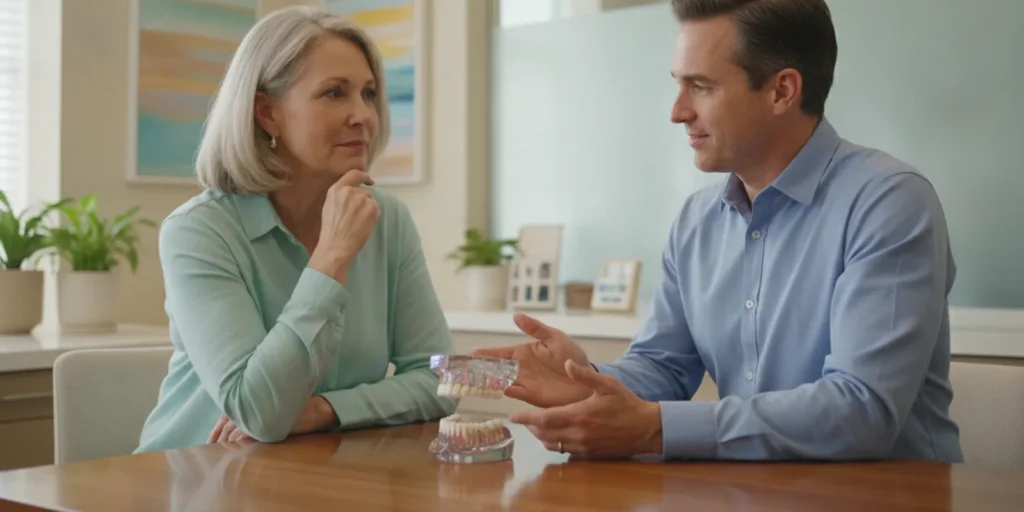
For adults comparing all-on-4 dental implants sacramento options, the most important question is not simply how many implants support a restoration. It is whether the proposed plan fits your oral health, remaining teeth, bone, bite, medical history, daily habits, and long-term goals. A board-certified prosthodontist can evaluate those factors and explain realistic choices before you commit to a complex course of care.
What does All-on-4 treatment involve?
All-on-4 is a full-arch approach in which a fixed set of replacement teeth is supported by four dental implants. The name describes a commonly used configuration, not a universal formula for every patient. The number, position, and design of implants depend on anatomy, the planned restoration, available bone, and clinical findings. A prosthodontist may discuss another fixed or removable approach when it better fits the situation.
The process generally includes a comprehensive evaluation, diagnostic planning, implant placement, a temporary restoration when appropriate, a healing period, and delivery of a final prosthesis. In the practice’s stated protocol, temporary teeth may be provided the same day as implant placement in suitable cases. The final prosthesis follows after healing and assessment, commonly around three to six months later. Individual timing can vary.
Full-arch care involves more than placing implants. The restoration must work with the bite, speech, facial support, chewing, cleaning access, and the patient’s expectations. A specialist trained in prosthodontics plans complex restorations as a connected system rather than treating the implant as an isolated part. Patients who want background on that specialty can read why someone may see a prosthodontist.
Who may consider a full-arch implant consultation?
People who have lost many teeth, have teeth that cannot be predictably restored, or currently wear removable dentures may want to learn about fixed full-arch options. That description does not establish eligibility. An examination and review of diagnostic records are necessary before any treatment recommendation.
Planning begins with a health-first question: can any natural teeth be preserved? If some teeth have a reasonable restorative outlook, saving them may be part of the discussion. Other factors include gum and bone support, the condition of remaining restorations, bite relationships, oral hygiene, medical and dental history, smoking or tobacco use, and the ability to maintain the proposed restoration. The guiding sequence is health first, then function, then appearance—not replacement for its own sake.
Some patients may be better served by a conventional denture, an implant-supported removable denture, a bridge, individual implants, or a staged restorative plan. Every option has trade-offs in stability, removability, maintenance, treatment stages, and cost. A consultation should explain why one design is being considered, what it can and cannot address, and what uncertainties remain. The practice’s overview of options for restoring lost teeth can help patients organize that comparison.
A full-arch conversation should also include the opposing arch and the rest of the mouth. A new restoration has to meet opposing teeth or a prosthesis, accommodate the bite, and function within the patient’s overall oral environment. Treating only the most obvious missing teeth may not address wear, instability, infection, or a failing restoration elsewhere. This is one reason a multi-visit specialist process can be useful for complex cases.
How is an All-on-4 plan developed?
A specialist-led plan starts with your goals and history, then connects those details to clinical findings. At Dr. Clark’s practice, the new-patient process is multi-visit: history and imaging are reviewed, an examination and diagnostic imaging are completed, and the patient receives education about the condition and possible options. Treatment planning then considers realistic expectations and next steps.
Depending on the case, evaluation may include the condition of existing teeth, gums and oral tissues, jaw relationships, bite forces, available bone, facial support, and the space available for a restoration. Imaging helps inform implant position and restoration design, but a scan is only one part of the assessment. The prosthesis must be planned before implant placement so that support, appearance, speech, and cleaning access are considered together.
If teeth need to be removed, extraction may be part of the sequence. If bone grafting is needed, healing before implant placement can add several months; the practice notes a typical three-to-six-month healing period. Not every patient needs grafting, and the need for it cannot be determined from a general online description. The appropriate sequence depends on examination and imaging. Patients can review the practice’s information on bone grafting before asking how it might affect their own timeline.
The plan may also address jaw function and bite stability. A patient who clenches or grinds, has an unstable bite, or has a history of jaw discomfort may need additional discussion before a final restoration is designed. This does not automatically rule out implants. It means the whole oral system belongs in the conversation. A history of previous dental work, difficulties with dentures, or problems keeping restorations clean is also worth sharing because it can influence design and instructions.
What happens between implant surgery and final teeth?
Even when a temporary set of teeth is placed on the day of surgery, treatment is not complete. The temporary restoration serves during healing while the implants integrate with bone and the clinical team monitors progress. Temporary teeth may have functional or dietary limitations, and follow-up visits allow the clinician to assess healing, comfort, bite, hygiene, and the condition of the restoration.
The final prosthesis is designed and delivered after appropriate healing and assessment. Factors that may shape the schedule include whether teeth need removal, whether grafting is needed, healing response, the complexity of the bite, the desired design, and laboratory fabrication. Appointments may be needed for examination, surgery, follow-up, adjustments, records, and delivery.
Implant integration commonly takes three to six months, but a calendar estimate is not a promise. Healing may progress differently from one person to another. Ask which milestones must be met before moving to the final restoration and what would cause the plan to change. A temporary restoration and a final prosthesis have different purposes, so ask what you should expect to eat, how you should clean, and which symptoms should prompt a call during each stage.
Patients can learn more about the clinical stages in the practice’s overview of the dental implant procedure. Understanding the sequence can make it easier to distinguish a same-day temporary restoration from the final result of treatment.
How does restoration design affect daily life?
A full-arch restoration should be evaluated as something you will live with, clean, and maintain every day. Ask how the design affects chewing, speech, access beneath the prosthesis, replacement of worn components, and professional maintenance. A restoration that looks acceptable at delivery still requires a practical home-care plan.
Material selection is individualized. The final teeth must balance strength, repairability, appearance, space, and access for cleaning. Color and tooth shape should be discussed in the context of facial features, lip support, speech, and the patient’s preferences rather than selected in isolation. The design should also account for how the restoration can be examined and serviced over time.
Dr. Clark’s practice has an in-house dental laboratory with digital design and fabrication capabilities. Direct collaboration between the clinician and laboratory team can support custom planning for complex restorations. The laboratory is one part of the workflow; it does not remove the need for clinical evaluation, healing, hygiene, and follow-up.
Before treatment, ask whether the proposed restoration is fixed or removable, how it is accessed for professional care, which parts can be repaired or replaced, and what maintenance appointments are expected. Ask whether the prosthesis can be removed only by the dental team or whether you will remove it at home. Also ask how often the restoration and implant components will be checked. These practical details can be as important to daily satisfaction as the initial surgical plan.
How do full-arch options compare?
The table below is a broad comparison for discussion, not a personal treatment recommendation. Specific designs, materials, stages, and fees vary with examination findings.
| Option | How it is supported | Planning and maintenance considerations |
|---|---|---|
| All-on-4-style fixed full arch | A fixed full-arch prosthesis supported by implants; four implants are a common configuration | May include same-day temporary teeth, a three-to-six-month healing period, a later final prosthesis, and careful cleaning access |
| Other fixed implant-supported full arch | A fixed prosthesis supported by an individualized implant arrangement | Implant number and position depend on anatomy, restoration design, bone, bite, and clinical findings |
| Implant-supported removable denture | A removable denture retained or stabilized by implants | Removability, stability, cleaning, component maintenance, and implant requirements should be compared |
| Conventional denture | A removable appliance supported primarily by oral tissues | Fit, retention, adaptation, relining, adjustments, and future tooth loss should be discussed |
| Natural-tooth restorative plan | Existing teeth are preserved and restored when their outlook allows | May involve crowns, bridges, periodontal care, or other staged treatment; prognosis must be assessed tooth by tooth |
For example, a person with several teeth that have a reasonable outlook may need a different conversation from someone whose remaining teeth are failing across an arch. Someone who prioritizes a removable appliance may value home removal and simpler access differently from someone seeking a fixed restoration. Someone with limited cleaning ability may need especially detailed instruction before choosing a design. Comparing those real-life requirements is more useful than selecting an option by name alone.
If preserving teeth is part of the discussion, the overview of procedures to save natural teeth may help you prepare questions. Patients comparing removable solutions can also review the practice’s information on what dentures are.
What should you know about cost and insurance?
A full-arch plan can include consultation, records, extractions when needed, implants, temporary and final restorations, laboratory work, and follow-up care. A written estimate should make clear what is included at each stage and which circumstances could affect fees. The practice lists All-on-4/All-on-X full-arch implants in a range of $25,000 to $60,000 per arch. The actual estimate depends on the case and proposed treatment; a range is not a quote.
Dr. Clark’s practice operates as private care and is out of network with all insurance. It does not participate in insurance plans or bill as an in-network provider. Patients can request detailed fees and contact their insurer to ask whether any out-of-network reimbursement may apply under their individual plan. Do not assume a plan will cover a particular service or amount.
Coverage language can be difficult to interpret because plans differ. For example, the 2026 Federal Employees Dental and Vision Insurance Program brochure describes an annual dollar limit for certain implant services under one option; this illustrates why benefit details must be checked against the specific plan rather than assumed. See the Federal Employees Dental Program brochure for that plan’s stated terms.
For a fuller discussion of fee structures, see the practice’s guide to private-care dentistry. Ask for the proposed stages, payment expectations, possible additional procedures, and included follow-up before deciding. A useful estimate should distinguish known planned services from conditional items that depend on examination, healing, or changes in the treatment sequence.
How can Sacramento-area patients prepare for a consultation?
Bring a clear account of your goals and concerns, along with relevant dental records or imaging if available. You do not need to decide on a procedure before the visit. Write down what has been difficult with your current teeth or dentures: loose fit, discomfort, chewing limitations, speech concerns, repeated repairs, or difficulty cleaning. These details help the clinician understand what you want a new plan to address.
A short list of questions can make a complex discussion easier to follow:
- What findings shape the proposed plan?
- Which natural teeth, if any, might be preserved?
- Is a fixed full arch the best fit, or should removable and tooth-preserving options be compared?
- How many stages are anticipated, and what could change the timeline?
- Would extractions or bone grafting be part of the proposed sequence?
- What can I expect from temporary teeth, including eating and cleaning limitations?
- How will the final restoration be cleaned, maintained, repaired, or replaced?
- What is included in the fee estimate, and what may be separate?
- How does my health history affect planning or healing?
- Who will coordinate the clinical and laboratory portions of the restoration?
Ask for explanations in plain language and take time to consider them. A multi-visit process gives you room to understand the diagnosis, compare options, and make an informed decision rather than committing before the details are clear. New patients can review new-patient resources before contacting the office.
What does specialist-level planning add?
A board-certified prosthodontist focuses on restoring oral function and appearance in complex cases, including implant and full-arch treatment. That focus matters because surgery and the final teeth are connected: implant position affects the restoration, the restoration affects cleaning and bite, and the bite can affect comfort and maintenance. Planning the entire sequence can help surface questions that may be missed when each step is considered separately.
Dr. Clark’s practice combines specialty training, a multi-visit consultation model, and an in-house lab. The stated philosophy is health first, then function, then beauty. In practical terms, that means the discussion begins with diagnosis and the condition of the mouth, moves to a workable restorative design, and then considers appearance within those clinical limits. It also means that a consultation is intended to educate and compare options, not rush a patient into a predetermined procedure.
Patients who want to understand the practice and its approach can read about the practice and its private-care model. The relevant question is not whether a particular label sounds appealing. It is whether the proposed plan is understandable, clinically coherent, maintainable, and appropriate for the patient’s goals and circumstances.
Frequently Asked Questions
Does All-on-4 always mean exactly four implants?
It refers to a commonly used full-arch configuration supported by four implants, but the appropriate design is determined by clinical findings. A prosthodontist can explain whether this configuration or another approach is being considered for your anatomy and restoration goals.
Are final teeth placed on the same day as implant surgery?
A temporary restoration may be placed the same day in appropriate cases. The final prosthesis is usually made after a healing period; the practice describes a typical three-to-six-month interval, subject to individual assessment and healing.
Will I need bone grafting?
That cannot be determined without examination and diagnostic records. If grafting is part of a plan, healing before implant placement can take several months; the practice notes a typical three-to-six-month period. Some patients do not need grafting.
How much do All-on-4 dental implants cost in Sacramento?
Fees depend on the clinical plan and what the estimate includes. Dr. Clark’s practice lists a $25,000-$60,000 range per arch for All-on-4/All-on-X full-arch implants. A consultation is needed for a case-specific estimate, especially if extractions, grafting, or additional restorative work is considered.
Does the practice accept dental insurance?
The practice is out of network with all insurance and does not participate in insurance plans. Patients may ask the office for fee information and contact their insurer about possible out-of-network reimbursement under their own policy.
For patients considering full-arch treatment in Sacramento, a careful specialist evaluation can clarify the diagnosis, compare realistic options, and establish a plan that puts oral health and function first.