


.
Replacing missing teeth later in life is not simply a question of age. Your general health, medications, gum condition, jawbone anatomy, healing capacity, and goals all help shape the safest treatment plan.
For many older adults, dental implants for seniors may be an option, but suitability depends on an individualized examination, medical history review, and diagnostic imaging rather than a birthday alone.
A systematic review of implant therapy in patients age 65 and older found evidence supporting implants as a predictable long-term option. The review also recognized that maintenance and biologic or technical complications remain possible. Understanding how implants work, including options such as an implant-supported overdenture, can make the decision more informed. Our guide to dental implant treatment provides broader background. The first step is understanding what safety means in the context of your own health.
Are Dental Implants for Seniors Safe for Older Adults?
Age by itself does not determine whether an older adult can consider implant treatment. A person in their 60s, 70s, or beyond may be evaluated for implants. But the decision depends on factors such as overall health, medications, oral condition, jawbone anatomy, healing considerations, and treatment goals. A careful evaluation is more meaningful than an age cutoff or a decision based on one medical condition.
What the evidence says about implant treatment in older adults
A systematic review evaluated implant therapy in patients age 65 and older. It concluded that implant therapy can be a predictable long-term option for elderly patients. The review also emphasized that outcomes depend on the patients, procedures, and follow-up conditions studied. This evidence is encouraging, but it is not a guarantee that treatment will be appropriate or produce a particular result for every individual. You can review the published analysis in PubMed’s systematic review of dental implants in elderly patients.
For a senior considering implants, safety begins with identifying the conditions that could affect surgery, healing, maintenance, or the design of the final restoration. The evaluation may include a review of medical and dental history, medications, prior hospitalizations, allergies, cardiovascular history, oral tissues, bite, and jawbone support. Diagnostic imaging helps the clinician understand anatomy and plan treatment rather than relying on assumptions about age.
Understanding possible complications
Implants are not maintenance-free, and responsible planning includes an honest discussion of potential complications. The elderly implant literature reports biologic issues such as inflammation of the tissues around an implant, mucosal enlargement, pain, bone loss, and implant loss. Technical or mechanical issues may include loosening of an abutment screw or fracture of an overdenture prosthesis. These possibilities do not mean that an older adult should avoid implants. They explain why the health of the surrounding tissues, the fit and function of the restoration, home care, and professional follow-up all matter.
Maintenance may involve regular examinations, professional cleaning, monitoring of the implant and prosthesis, and prompt attention to changes such as soreness, bleeding, looseness, or difficulty chewing. An older adult’s needs can also change over time, so a restoration should be planned with long-term access and practical daily care in mind. The right approach is individualized, measured, and based on a complete examination rather than age alone.
What Medical Factors Matter for Senior Implant Patients?
Age is only one part of an implant evaluation. A thoughtful assessment considers your overall health, oral condition, medications, jawbone support, healing capacity, and goals. The purpose is not to place a label on you as a candidate based on one diagnosis. It is to understand the complete clinical picture and identify which options can be considered safely and realistically.
Health history and chronic conditions
During the intake process, your dental team should review relevant health conditions, previous hospitalizations, allergies, cardiovascular history, and current medications. This information helps shape the examination, imaging, treatment sequence, and coordination that may be needed with your other clinicians. Bring an up-to-date medication list and be prepared to discuss significant changes in your health since your last dental visit.
Diabetes and osteoporosis deserve particular attention because the way these conditions are managed can affect healing considerations. They do not automatically rule out implant treatment, and a diagnosis alone cannot determine whether treatment is appropriate. The important question is how your condition is being managed and how it fits with your oral health and proposed care. Your implant provider may need relevant information from your physician before finalizing a plan, but only your treating clinicians can advise you about your medical management.
Medications and cardiovascular history
Some medications and cardiovascular conditions can influence planning, bleeding considerations, healing, or the need for communication between your dental and medical teams. This is why you should disclose every prescription medication, over-the-counter product, and supplement you use, along with major procedures or hospitalizations. Do not stop, skip, or change a medication because of something you read about dental implants. If a medication or health condition raises a question, the appropriate next step is coordination between the clinicians responsible for your care.
Oral health and informed planning
Medical history is only one side of the assessment. The examination also considers gum health, active infection, remaining teeth, bite function, oral hygiene, anatomy, and available jawbone support. A review of health factors and jawbone support is central to determining which implant options may be reasonable for an individual (source discussion of senior implant evaluation). Three-dimensional imaging and a detailed clinical examination can help the team understand anatomy that cannot be judged from age or a smile photograph alone.
At Dr. Jefferson Clark Personalized Oral Health, the multi-visit consultation is designed to make this process deliberate. You can discuss alternatives, expected steps, limitations, maintenance, and your priorities before committing to treatment. That informed planning, with physician coordination when appropriate, helps ensure that any recommendation reflects your health and anatomy rather than a one-size-fits-all assumption.
How Do Bone Density and Healing Affect Treatment?
Implants need enough healthy jawbone in the right location to provide stable support. That assessment involves more than asking whether a patient has “good” or “bad” bone density. The available bone may be affected by the length of time since tooth loss, periodontal disease, previous infection, trauma, anatomy, and the location of the missing tooth. For older adults, the quality and volume of bone are considered alongside medical history, oral function, treatment goals, and the ability to maintain the restoration.
Why three-dimensional imaging matters
A clinical examination and two-dimensional X-rays provide useful information, but three-dimensional imaging can show the anatomy in greater detail. At Dr. Clark’s practice, 3D imaging helps assess the width and height of the jawbone, the position of nearby structures, and the space available for a planned implant. It also supports a more precise discussion of treatment options. Imaging is not a promise of candidacy. It is one part of a diagnostic process that helps a board-certified prosthodontist explain what may be possible and what sequence may be safest for the individual patient.
When bone grafting may be considered
Significant bone loss may mean that additional treatment is considered before implant placement. A graft can sometimes help rebuild deficient bone. But whether it is appropriate depends on the location and extent of the loss, the cause, overall health, and the proposed restoration. This possibility is also discussed in clinical guidance for older implant patients (senior implant considerations). Patients researching implant candidacy after bone loss can learn more about how that evaluation differs from a simple checklist. When grafting is part of the plan, it may add a healing stage before the implant procedure. A separate guide to bone grafting before implants explains the rationale and general process in greater detail.
Healing is individual
After placement, the implant and surrounding bone need time to heal and integrate. Older adults may experience a somewhat longer healing period, but age is only one factor, as noted in the available discussion of implant healing for seniors (healing considerations for older adults). Bone characteristics, the number and location of implants, grafting, health conditions, oral hygiene, smoking status, and adherence to follow-up instructions can all influence the schedule. A treatment plan should therefore provide an individualized timeline rather than a universal promise.
A systematic review of implant therapy in elderly patients reported relatively small average changes in the bone level around implants at one year. Ranging from 0.1 to 0.3 mm, and a reported change of 0.7 mm at five years (review of implant outcomes in elderly patients). These findings come from a specific evidence review and do not predict an individual outcome. They also reinforce why periodic examinations and professional maintenance remain important. The tissues around an implant can develop inflammation or bone loss, and restorations can experience mechanical problems. Monitoring gives the care team an opportunity to identify concerns and respond before they become more difficult to manage.
Are Implants Better Than Dentures for Seniors?
There is no universal winner between implants and dentures. The more useful question is which approach fits your anatomy, health history, daily needs, and preferences. Traditional dentures can replace a full arch without implant surgery and may be appropriate when a removable option is preferred. Implants, meanwhile, can anchor a fixed restoration or support a removable overdenture, often improving stability for people who struggle with movement or soreness.
For some older adults, the choice is not between an entirely fixed implant restoration and conventional dentures. An implant-supported overdenture is a middle option. In one prospective study, 53 adults aged 60 and older received a mandibular overdenture supported by two implants. The study assessed clinical, radiographic, and patient-reported outcomes over a long period, but its findings do not mean that the same design is appropriate for every patient.
| Consideration | Traditional dentures | Implants or implant-supported restorations |
|---|---|---|
| Stability | Rest on the gums and may move, particularly as the mouth changes over time. | Implants can provide an anchor, although the design may be fixed or removable. |
| Chewing and function | Can restore useful function, but performance depends on fit, support, and adaptation. | May offer greater resistance to movement during chewing, depending on the restoration and anatomy. |
| Maintenance | Requires daily cleaning, professional checks, and possible adjustments or replacement as fit changes. | Requires cleaning around the implants and restoration, follow-up visits, and repairs when needed. |
| Anatomy | Does not require implant placement, but comfort and retention depend on available oral support. | Requires adequate conditions for implant placement or additional planning when anatomy is limited. |
| Treatment timeline | May be delivered without the healing period associated with implant placement. | Includes surgical planning and healing, with timing tailored to the patient’s condition and restoration. |
| Patient preferences | May suit someone who values removability, avoids surgery, or prefers a simpler treatment path. | May suit someone who prioritizes additional stability and accepts surgery, healing, and ongoing maintenance. |
Implant treatment is not maintenance-free. Research in older adults has reported mechanical issues, including abutment screw loosening and overdenture fracture. It has also reported biologic concerns such as inflammation, bone loss, pain, and implant loss. Regular professional care and effective home cleaning remain important. A detailed comparison of dentures versus dental implants can help you understand the broader tradeoffs. A prosthodontic evaluation can then connect those general differences to your anatomy, health considerations, functional goals, and comfort with a removable or fixed restoration.
What Does the Consultation Process Look Like for Senior Patients?
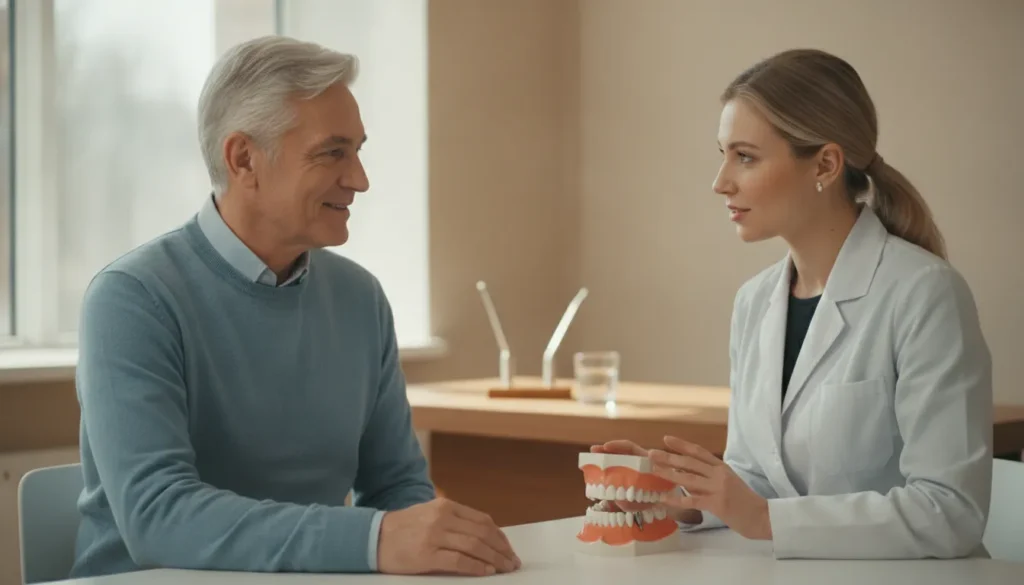
A careful consultation is designed to replace uncertainty with a clear understanding of your oral health, available options, and the decisions ahead. For older adults, that means looking beyond a missing tooth or uncomfortable denture. The evaluation considers medical history, medications, existing teeth and restorations, jaw anatomy, functional goals, and the type of support you may need at home during treatment.
Clinical evaluation commonly includes an examination, X-rays or three-dimensional images, and discussion of an implant plan, as described by WebMD. At Dr. Clark’s practice, this work is intentionally spread across visits so you have time to ask questions and consider the plan rather than making a rushed decision.
- Review of your history and records. The first step includes your dental history, medical conditions, prior hospitalizations, allergies, cardiovascular history, and current medications. Bring copies of relevant dental records and imaging if available. A written medication list, including doses and supplements, helps the team understand the full clinical picture. Diabetes, osteoporosis, and other conditions may affect healing considerations, but no single condition automatically determines candidacy.
- Examination and review of existing imaging. Dr. Clark examines your teeth, gums, bite, jaw joints, available bone, and current dentures or restorations. Existing X-rays can provide useful background, but they may not answer every planning question. The goal is to identify active concerns and understand how tooth replacement fits your overall function.
- New three-dimensional imaging. When appropriate, new 3D imaging helps assess anatomy and develop a surgical plan. This is an important part of individualized planning because bone volume, neighboring structures, and the condition of the remaining teeth vary from patient to patient. The imaging findings may influence the sequence of care and the options discussed.
- Education and comparison of options. You will have an opportunity to discuss conventional dentures, implant-supported restorations, staged treatment, and other approaches. Ask about chewing function, maintenance, appointments, healing, and how each option fits your goals. You can also learn what a prosthodontist does when complex restorative decisions require advanced training.
- Expectations and a detailed plan. Dr. Clark reviews the anticipated sequence, possible limitations, responsibilities, and questions that remain. As a board-certified prosthodontist, he coordinates the restorative design with the surgical and functional goals. The in-house dental laboratory supports close collaboration on customized restorations through digital and CAD/CAM workflows.
- Scheduling and financial discussion. Once you understand the recommended plan, the team can discuss visit timing, sequencing, scheduling, and financing. The practice provides private care and is not in network with insurance companies. Treatment decisions should be based on your health, anatomy, priorities, and informed understanding of the plan, not age alone.
Before your visit, write down your goals and questions. Consider what you want to improve, how much time you can devote to appointments, and what support may be available during recovery. A thoughtful consultation gives you the information needed to make a decision that feels appropriate for your circumstances.
Frequently Asked Questions
Are dental implants safe for seniors?
Dental implants may be safe for many older adults, but safety depends on overall health, oral condition, medications, bone anatomy, and treatment goals. Age alone does not determine candidacy. A systematic review found implant therapy can be a predictable long-term option for elderly patients, while also noting that biologic and technical complications can occur and require maintenance: systematic review evidence.
Should a 70-year-old get dental implants?
A 70-year-old may be a candidate, but no one can determine that from age alone. The evaluation should consider medical history, healing considerations, gum and jawbone health, imaging findings, existing teeth or dentures, and the person’s priorities. A thorough consultation can clarify whether implants, an implant-supported denture, or a conventional denture better fits the situation.
How long is recovery after getting dental implants?
Recovery varies according to the number and location of implants, the condition of the bone and gums, whether grafting is needed, and your general health. Some early soreness is expected, but the time needed for the implant and bone to integrate is individualized. Your treatment plan should explain each healing phase rather than promise a universal recovery schedule.
Does Medicare or dental insurance cover implants?
Coverage depends on the specific plan, the reason for treatment, and its exclusions, so confirm benefits directly with your insurer before making decisions. Dr. Clark’s practice is private care and is not in network with insurance companies. During planning, the team can discuss expected fees and available financing information, but insurance benefits cannot be guaranteed.
Schedule a Consultation for Personalized Implant Planning
A thoughtful evaluation can help clarify how your health, anatomy, goals, and preferences may shape dental implant options. Dr. Clark’s multi-visit consultation process gives you time to review findings, discuss alternatives, and understand the proposed path before making a decision. To discuss personalized dental implant options for seniors, schedule a consultation with our office.