


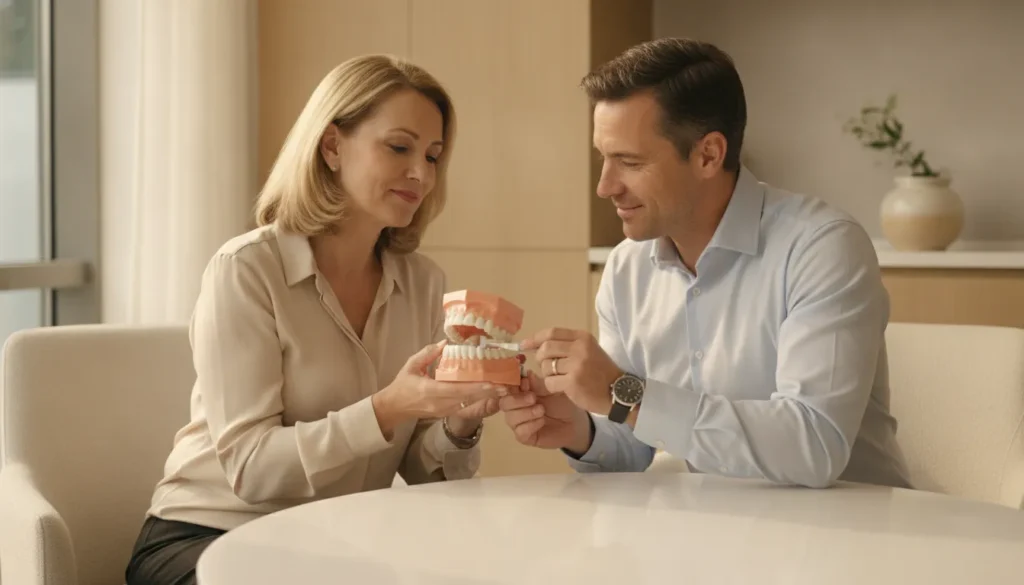
Dental implants are designed to replace missing teeth, but the restoration, surrounding gum tissue, and your remaining natural teeth still need consistent care. A thoughtful routine helps remove daily biofilm, protect the gumline, and identify changes before they become more difficult to manage. Your treating clinician’s instructions should take priority because the right tools and recall schedule depend on your restoration design, gum health, medical history, and overall treatment plan. For a broader look at dental implant treatment options, individualized planning matters from the beginning.
To understand how to care for dental implants, clean them gently every day. Clean between the restoration and adjacent teeth, protect against damaging habits, and keep the follow-up visits your clinician recommends. Implants cannot develop cavities, but the tissues around them can still develop inflammation, infection, or bone loss.
The daily routine begins with the fundamentals: choosing tools that fit your restoration and cleaning each part of your smile without excessive force.
Daily Cleaning Routine for Dental Implants
A consistent routine supports the health of the restoration, the gum tissue around it, and any natural teeth that remain. Your treating clinician’s instructions take priority, because the appropriate technique can vary with the restoration design, gum health, medical history, and access around the implant.
- Brush in the morning and before bed. Use a soft-bristled toothbrush and clean the visible surfaces of the implant-supported restoration as well as your natural teeth. Brush gently along the gumline rather than scrubbing aggressively. The restoration cannot develop a cavity, but plaque can still collect on and around it, and the neighboring natural teeth remain vulnerable to ordinary tooth decay.
- Clean the gumline around the implant. Angle the brush so the bristles reach the junction between the restoration and the surrounding gum tissue. For a removable or full-arch restoration, ask your clinician to demonstrate how to access the tissue beneath and around the prosthesis. Do not assume that a technique suitable for a single crown will also be appropriate for a larger restoration.
- Clean between teeth and around the implant every day. Use the interdental method recommended for your anatomy and restoration, such as implant-safe floss or an interdental brush. Work carefully around contact points and beneath accessible areas without forcing a device into tight tissue. Daily interdental cleaning is part of proper implant care, but the best tool and technique should be selected with your dental team.
- Inspect without diagnosing. As you clean, notice changes such as bleeding, swelling, tenderness, drainage, looseness, or a change in how your teeth meet. Biofilm can contribute to inflammation in the soft and hard tissues around implants. A review in PubMed describes peri-implant diseases as primarily biofilm-mediated inflammatory conditions and identifies bleeding on gentle probing as a clinical feature of peri-implant mucositis. Bleeding during home care does not establish a diagnosis, but persistent or worsening changes deserve professional evaluation rather than self-treatment.
- Finish according to your individualized plan. If your clinician has recommended a water flosser, mouth rinse, or another aid, use it as directed. Record questions about difficult-to-clean areas and bring them to your maintenance visit. Implant care depends on the complete oral environment, not only the artificial tooth, so continue caring for every remaining natural tooth.
The right tools make this routine easier to perform accurately, especially when a restoration has contours or spaces that are difficult to reach. The next section explains how to choose those tools without assuming that one product works equally well for every implant patient.
How to Care for Dental Implants With the Right Hygiene Tools
The most useful implant-care tools are the ones that let you clean the restoration, the gum tissue around it, and your remaining natural teeth without causing unnecessary irritation. Dental implants do not develop cavities, but the tissues around them can develop inflammation or infection, so daily removal of biofilm remains important. Research describes peri-implant diseases as biofilm-mediated inflammatory conditions affecting the soft and hard tissues around an implant (PubMed review).
There is no single universal kit for every patient. A single crown, an implant-supported denture, and a full-arch restoration can have very different contours and access points. Your restoration design, gum health, medical history, and treating clinician’s instructions should determine the final selection.
| Tool | How it may help | Selection considerations |
|---|---|---|
| Soft-bristle toothbrush | Cleans the restoration surfaces and gumline with gentle, consistent brushing. | A soft-bristled brush used at least twice daily is a commonly recommended foundation. Use the technique your clinician demonstrates. |
| Low-abrasive toothpaste | Provides a toothpaste medium for brushing without making aggressive polishing the goal. | Ask which formula is appropriate for your restoration and remaining teeth. Avoid choosing based only on whitening claims. |
| Implant floss or interdental brush | Reaches spaces between teeth and beneath or around accessible restoration contours. | The correct size and shape depend on the space and restoration. Daily interdental cleaning is part of proper implant care. |
| Water flosser | Can help flush debris from areas that are difficult to reach with string floss alone. | It may be particularly useful for some full-arch designs, including All-on-4, but it is not automatically the best choice for every patient. |
| Mouth rinse | May be included as an additional measure in an individualized hygiene plan. | Use it only as directed. A rinse does not replace brushing, interdental cleaning, or professional evaluation. |
For example, a patient with a single implant crown may need careful brushing and a small interdental brush. While a patient with a full-arch restoration may need a water flosser or another method to access the underside. The goal is not to collect every available device. It is to use a manageable combination that cleans the relevant surfaces without damaging soft tissues or the restoration.
Bring your current tools to a maintenance visit if you are unsure whether they fit properly. Your dental team can check your technique, identify areas where plaque collects, and adjust the plan as your restoration or gum health changes. Follow your own clinician’s instructions, particularly after implant treatment or when you have bleeding, swelling, persistent discomfort, or difficulty cleaning a specific area.
Foods and Habits That Shorten Implant Lifespan
Dental implants are designed to restore function, but the forces and conditions around them still matter. Certain habits can place extra stress on the implant-supported restoration, irritate the surrounding tissues, or make inflammation more difficult to control. They do not guarantee failure, and avoiding them cannot guarantee a particular lifespan. Instead, think of these behaviors as modifiable risk factors within a larger plan for how to care for dental implants.
Use care with hard foods and objects
Chewing ice is a particularly unhelpful habit because it exposes a restoration to repeated, forceful contact. The same caution applies to using teeth or an implant restoration to open packages, crack shells, or bite non-food objects. Even when the implant itself remains stable, excessive force may chip a crown, loosen a component, or affect the way the restoration contacts the opposing teeth. A periodontal practice specifically advises patients to stop chewing ice when protecting implants, but your prosthodontist should guide decisions based on your restoration design and bite.
Food choices immediately after surgery require a separate discussion. During early healing, the treating team may provide instructions about texture, temperature, chewing, and the surgical area. Those instructions take priority over general long-term advice. For a practical overview of that recovery period, see foods after implant surgery. Once healing is complete, the goal is not usually a permanently restrictive diet. It is sensible eating, careful chewing, and prompt attention if a restoration feels different or uncomfortable.
Address clenching and grinding
Clenching and grinding can transfer substantial force through an implant crown, bridge, denture, or full-arch prosthesis. Because an implant does not have the same periodontal ligament feedback as a natural tooth, you may not perceive every force in the same way. If you wake with jaw soreness, notice worn or chipped teeth, or have been told that you grind, discuss it with your clinician. A professionally selected mouthguard may help protect teeth and an implant, although the appropriate design depends on your bite and restoration.
Reduce risks linked to smoking and health conditions
Smoking is associated with a higher risk of peri-implant disease, and a review reports higher risk among patients with a history of periodontitis or smoking. The same review identifies uncontrolled diabetes as an associated risk factor. These findings describe population-level associations, not a prediction for one person. They do support a practical approach: avoid smoking, work with your medical team to manage diabetes and other health conditions. And tell your dental team about relevant medications or changes in health. Better control supports a more informed maintenance plan; it does not replace daily cleaning or professional follow-up.
Peri-implant diseases are biofilm-mediated inflammatory conditions that can affect the soft and hard tissues around an implant. More frequent maintenance may reduce risk for some patients, particularly when gum history, medical conditions, or restoration design warrants closer monitoring. Ask your treating clinician how often you should be seen rather than adopting a universal schedule.
Regular Check-Ups: What Your Prosthodontist Monitors
Professional follow-up is not simply a routine cleaning with an implant added to the checklist. It is an opportunity to evaluate how the restoration, the tissues around it, your bite, and your home-care routine are functioning together. Dental implants still require daily hygiene and professional follow-up, even though the implant itself cannot develop a cavity. The surrounding tissues can become inflamed or affected by disease, and the restoration can experience wear or damage over time.
The tissues around the implant
Your clinician may inspect the gum tissue around each implant for swelling, redness, bleeding, recession, drainage, or other changes. Plaque and biofilm are clinically important because peri-implant diseases are primarily biofilm-mediated inflammatory conditions that can affect both the soft and hard tissues around an implant. A research review describes peri-implant mucositis as an inflammatory lesion without additional marginal bone loss beyond initial remodeling. And bleeding with gentle probing can be one of its clinical characteristics. These findings do not provide a diagnosis by themselves, but they help your dental team identify changes that deserve attention. Read the clinical review on peri-implant inflammation.
Restoration integrity and bite
A follow-up visit may also include an assessment of the crown, bridge, denture, or full-arch prosthesis supported by the implants. The clinician may look for worn, loose, chipped, or damaged components, as well as areas that are difficult for you to clean. Your bite matters, too. Changes in how the teeth contact one another can influence comfort, chewing, and the forces placed on a restoration. Tell your care team if your bite feels different, if a restoration moves, or if chewing has become uncomfortable rather than trying to adjust the area yourself.
Home-care technique and individualized planning
Check-ups are also a chance to review how you are cleaning the restoration and the spaces around it. Your clinician or hygienist may watch your technique, identify areas where plaque collects, and recommend tools that fit your restoration design and gum health. There is no single recall schedule or universal tool that suits every patient. Intervals may vary according to the restoration, tissue health, medical history, risk factors, and your clinician’s instructions. One periodontal practice recommends evaluation and cleaning at least twice a year, while research indicates that more frequent maintenance may reduce peri-implantitis risk for some patients. That is a starting point for discussion, not a rule for everyone.
When imaging may be useful
Imaging is not necessarily required at every visit. Your prosthodontist may recommend it when clinical findings, symptoms, a change in function, or the restoration’s history makes a closer evaluation appropriate. Thorough implant planning uses examination and diagnostic imaging, and ongoing care similarly depends on integrating clinical findings with the individual patient’s needs. Specialist planning can be particularly valuable when several implants, an implant-supported denture, or a full-arch restoration must work as one system. An in-house lab can support customized restoration evaluation and adjustment through digital imaging, CAD/CAM, 3D printing, and milling, but technology does not guarantee a particular outcome or lifespan. Learn more about dental implant treatment options and custom implant restorations.
Warning Signs That Something May Be Wrong
Dental implants cannot develop cavities, but the gum and bone around an implant can still become inflamed or infected. These tissues support the implant and its restoration, so changes in comfort, appearance, or function deserve attention. Peri-implant diseases are primarily biofilm-mediated inflammatory conditions that can affect the soft and hard tissues around an implant. Research on peri-implant disease describes bleeding with gentle probing as a clinical feature of peri-implant mucositis, while peri-implantitis can involve deeper tissue changes.
A warning sign does not tell you exactly what is happening. Similar symptoms can have different causes, including irritation, a bite issue, a loose component, a damaged restoration, or inflammation around the implant. Do not try to diagnose peri-implant disease at home or treat it with increasingly aggressive brushing, unprescribed products, or leftover medication. Contact the dental team that treats you and describe what you are noticing. Professional evaluation is especially important when symptoms persist, worsen, or affect eating and speaking.
Symptoms that warrant a call
- Persistent or increasing pain: Ongoing tenderness, pressure, or discomfort after the expected recovery period should be evaluated rather than ignored.
- Swelling or redness: New or worsening swelling in the gum around an implant, or swelling elsewhere in the mouth, may signal inflammation that needs professional assessment.
- Bleeding: Bleeding during gentle brushing or interdental cleaning is not something to dismiss as normal. It can be associated with inflammation around the implant, although only an examination can determine the cause.
- Drainage or an unpleasant taste: Pus-like drainage, persistent fluid, or a bad taste near the implant should prompt a call to the treating team.
- Looseness or movement: An implant restoration, crown, bridge, denture, or other component should not be moving unexpectedly. Avoid testing it repeatedly with your fingers or tongue.
- A change in your bite: If your teeth no longer meet as they did, or one area suddenly receives more pressure, report the change. Altered bite forces can be relevant to both the restoration and the surrounding tissues.
- A crack, chip, or damaged restoration: A broken crown, bridge, denture tooth, screw-access filling, or other visible change should be assessed. Do not glue a restoration back in place or modify it yourself.
When you call, note when the symptom began, whether it is getting worse, and whether it occurs with chewing, brushing, or at rest. Continue only the home-care steps your clinician has already recommended, and follow any specific instructions for your restoration. Your cleaning tools and follow-up plan may depend on the restoration design, gum health, medical history, and treatment history.
Daily maintenance remains important, but it is not a substitute for evaluation when something changes. If you want to read more about prevention while keeping this article’s focus on routine care and symptom escalation, see how to reduce dental implant risks. Most importantly, contact your treating dental team promptly when you notice persistent pain, swelling, bleeding, drainage, looseness, a bite change, or damage to the restoration.
Frequently Asked Questions
How do I properly care for my dental implants?
Brush at least twice daily with a soft-bristled toothbrush, clean between your teeth and around the implant-supported restoration every day, and keep your regular professional visits. Your routine should address the restoration, the gum tissue around it, and any remaining natural teeth. The best interdental tool depends on your restoration design, gum health, medical history, and treating clinician’s instructions. Daily brushing and interdental cleaning guidance supports these basic maintenance steps.
Can dental implants get gum disease?
An implant cannot develop a cavity, but the gum and bone around it can become inflamed or infected. Peri-implant diseases are primarily biofilm-mediated inflammatory conditions affecting the soft and hard tissues around implants (PubMed review). Bleeding with gentle professional probing, persistent swelling, drainage, pain, or looseness should prompt an evaluation by your treating dental team rather than self-treatment.
How often should I visit my dentist or periodontist after getting dental implants?
There is no single recall schedule that fits every implant patient. Your clinician may adjust visits based on the restoration, gum health, medical history, home-care routine, and findings at each examination. One periodontal practice recommends evaluation and cleaning at least twice a year, while a review reports that more frequent maintenance may reduce peri-implantitis risk. Follow the interval set by your treating team and contact the office sooner if symptoms or a bite change develop.
Schedule a Consultation for Personalized Implant Care
Consistent home care and thoughtful follow-up can help you protect your restoration, surrounding tissues, and remaining natural teeth. A prosthodontic evaluation can clarify which maintenance approach fits your implant design, hygiene needs, and long-term goals. Schedule A Consultation to discuss your questions and create a care plan with your treating team.