



If you are asking, “Are dental veneers permanent?” you deserve a precise answer before agreeing to treatment. Many traditional porcelain veneers are considered irreversible because a dentist may remove a small amount of enamel to create room for the restoration. That does not mean veneers last forever, or that every veneer treatment involves the same degree of preparation. The right answer depends on the material, the design, your enamel, your bite, and your oral health.
Discuss your goals and options with a board-certified prosthodontist before making a permanent change.
Are dental veneers permanent?
Most traditional porcelain veneers are a permanent, non-reversible treatment because placing them can require removing some natural enamel. However, “permanent” describes the commitment to the tooth, not an everlasting lifespan. Veneers can eventually need repair or replacement, while minimal-prep, no-prep, or composite options may be more conservative in carefully selected cases.
Veneers are thin custom restorations bonded to the front of teeth. They can improve the appearance of discoloration, chips, gaps, mild unevenness, or worn edges. A veneer is not a removable cover that you can take off at night and return to the exact untreated tooth underneath.
The Cleveland Clinic’s overview of dental veneers also distinguishes between permanent veneer treatment and options such as no-prep or minimal-prep veneers, which may be reversible in some situations. That distinction is important: the label alone does not tell you how much tooth structure will be changed.
Why are traditional veneers considered irreversible?
Traditional veneers are considered irreversible when the treatment plan includes enamel preparation. Once natural enamel has been reshaped, it does not grow back. After preparation, the tooth may need a veneer or another restoration to protect its appearance and function, even if the original veneer is later removed.
What tooth reduction actually involves
Preparation is not supposed to be a standard amount taken from every tooth. A prosthodontist evaluates tooth shape, color, alignment, bite, existing restorations, and the thickness needed for the selected material. The goal is to create enough space for a natural-looking restoration while preserving as much healthy structure as the case allows.
Research on minimally invasive ceramic veneers emphasizes careful preparation within enamel when possible, while also noting that tooth anatomy and the desired result affect how much preparation is feasible. You can review the clinical discussion in Minimally invasive veneers: current state of the art.
- Enamel preservation: Bonding to enamel is generally more predictable than bonding to dentin, so preserving healthy enamel matters.
- Room for the restoration: The veneer needs to fit without making the tooth look bulky or interfering with your bite.
- Color management: Heavily discolored teeth may require a different design or material thickness than lightly stained teeth.
- Functional planning: Grinding, clenching, edge-to-edge contact, and an unstable bite can change whether veneers are appropriate.
Are no-prep or minimal-prep veneers reversible?
Sometimes, but not automatically. A no-prep or minimal-prep approach may be conservative when tooth shape, position, enamel, and the desired change make it possible. If a veneer is bonded to enamel without changing the tooth, removal may be more conservative. In other cases, even a minimally prepared design can involve an irreversible change. Ask exactly what will be altered, not just whether a treatment is marketed as no-prep.
Does permanent mean veneers last forever?
No. A veneer can be a permanent commitment while still being a restoration with a finite service life. Dr. Clark’s veneer information describes porcelain veneers as typically lasting 10 to 15 years with proper care. The actual lifespan varies with material, fit, bite forces, habits, hygiene, and regular professional maintenance.
It is more accurate to think of veneers as long-term restorations that may eventually need maintenance, repair, or replacement. A 2020 systematic review of porcelain laminate veneers found generally high and predictable outcomes, but also noted that the research is heterogeneous and that there is not a conclusive estimate of longevity beyond 20 years. Read the review in the European Journal of Dentistry via PubMed Central.
| What people mean by “permanent” | What it actually means |
|---|---|
| The tooth will never need attention again | Not guaranteed. Veneers can wear, chip, loosen, stain at the margins, or need replacement. |
| The treatment cannot be undone | Often true when enamel was prepared. The tooth does not return to its original untreated state. |
| The veneer will last forever | Not true. Longevity depends on the restoration, the tooth, the bite, and daily care. |
Habits that can help protect veneers include:
- Brush with a soft-bristled toothbrush and clean between your teeth daily.
- Do not use veneered teeth to open packages or bite non-food objects.
- Discuss a custom nightguard if you grind or clench your teeth.
- Keep routine dental visits so your dentist can assess the teeth, gums, bite, and veneer margins.
- Tell your dentist promptly if a veneer feels loose, changes your bite, or develops a sharp edge.
There is no responsible way to guarantee a specific lifespan or aesthetic result. A careful diagnosis and a plan that accounts for function are more valuable than a promise of permanence.
Schedule a consultation if you want to understand whether veneers fit your oral health, bite, and long-term goals.
Are there reversible alternatives to veneers?
Yes. Depending on the concern, alternatives may include professional whitening, cosmetic bonding, orthodontic treatment, or simply monitoring a healthy tooth. Composite bonding is often more conservative and may be repairable or reversible, but it has different durability, stain resistance, and maintenance considerations than porcelain.
The best alternative depends on what you want to change. Whitening may address color but cannot reshape a tooth. Bonding can address small chips, gaps, or shape changes without the same type of ceramic restoration. Orthodontic treatment may be more appropriate when tooth position is the main concern. A crown may be considered when a tooth needs more structural coverage, but a crown is not a conservative substitute for every cosmetic issue.
| Option | What it may address | Key commitment question |
|---|---|---|
| Porcelain veneers | Color, shape, minor alignment, chips, gaps, or worn edges | Will enamel preparation be needed, and how will the bite be protected? |
| Composite bonding | Small chips, minor shape changes, selected gaps, and some discoloration | Will the resin’s maintenance and staining risk fit my expectations? |
| Professional whitening | Natural tooth discoloration without changing tooth shape | Will whitening address the concern, or is the issue structural? |
| Orthodontic treatment | Tooth position and certain spacing or alignment concerns | Would moving natural teeth solve the concern more conservatively? |
When composite bonding may be a better fit
Composite bonding may be worth discussing when preserving natural tooth structure is the priority and the desired change is modest. Dr. Clark’s practice describes cosmetic bonding as a conservative approach that is usually completed in one visit, with a typical lifespan of 5 to 7 years. It can also be more prone to staining or chipping than porcelain. Learn more about cosmetic bonding in Roseville.
That does not make one option universally better. The right choice balances preservation, appearance, function, maintenance, and your expectations.
What happens when veneers need replacing?
When veneers need replacing, a prosthodontist first examines the restoration, the underlying tooth, the gums, and the bite. The next step may be polishing, repair, replacement, or a different restoration. Because the tooth has already been prepared, replacement planning should protect remaining structure and address the reason the first restoration failed.
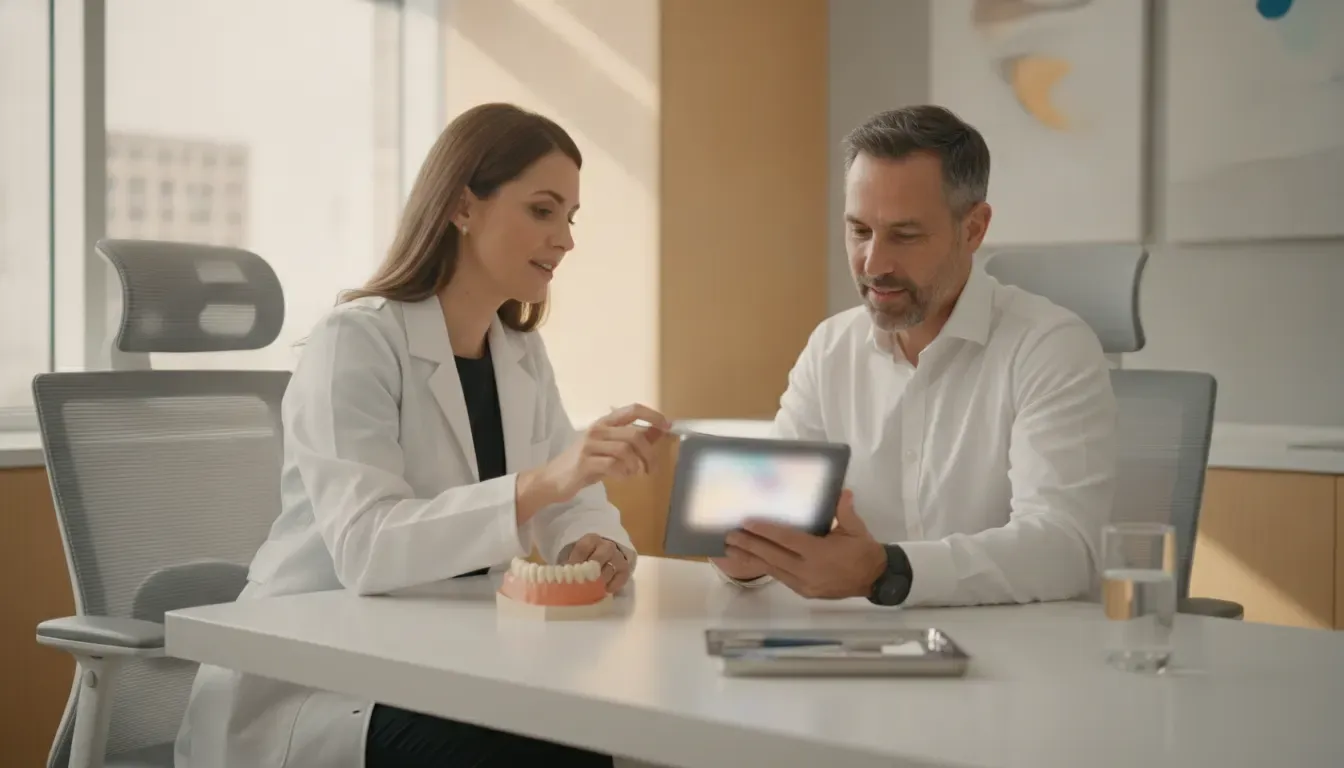
A replacement is not necessarily a sign that veneers were a mistake. Restorations experience normal wear, and teeth and gums can change over time. However, repeated breakage, sensitivity, new decay, gum inflammation, or bite discomfort deserves evaluation rather than simply replacing the visible shell.
Ask about:
- Whether the current veneer can be repaired or must be removed.
- How much healthy enamel remains.
- Whether clenching, grinding, or bite contacts contributed to the problem.
- Whether the tooth needs a veneer, bonding, a crown, or another option.
- How the new design will be fabricated, fitted, and maintained.
An in-house dental laboratory can support close communication between the dentist and the laboratory team during custom restoration planning. Dr. Clark’s in-house dental lab uses digital design, 3D printing, and 5-axis milling as part of the practice’s restorative workflow.
What should you ask before committing to veneers?
Before committing, ask what will happen to your natural enamel, which material is recommended and why, how your bite will be assessed, what alternatives may meet your goals, and how future maintenance will be handled. A consultation should leave you informed enough to choose treatment without pressure.
- Will you need to remove enamel? If so, where and why?
- Is a no-prep or minimal-prep option clinically appropriate for my teeth?
- What oral health issues must be treated before cosmetic care?
- How will you evaluate my bite, clenching, grinding, and tooth wear?
- What alternatives could preserve more natural tooth structure?
- How long might the proposed restoration last in my specific situation?
- What happens if the veneer chips, loosens, or needs replacement?
A board-certified prosthodontist evaluates aesthetics and function together. That matters because a veneer plan should fit your whole oral system, not just the portion of a tooth visible in a photograph. Dr. Clark’s prosthodontic specialty training focuses on complex restoration, function, and long-term planning.
Review your options with Dr. Jefferson Clark in Roseville, serving patients from Rocklin, Granite Bay, Folsom, and the greater Sacramento area.
Frequently Asked Questions
Can dental veneers be removed?
They can be removed by a dental professional, but removing a traditional veneer does not restore the original untreated tooth if enamel was prepared. The tooth may need a new veneer or another restoration. Never try to remove a veneer yourself.
Are no-prep veneers always reversible?
No. No-prep and minimal-prep labels describe an approach, not a guarantee. Reversibility depends on the actual tooth preparation, bonding, fit, and clinical circumstances. Ask to see the proposed plan and understand exactly what will change.
Do veneers damage natural teeth?
Veneers do not automatically damage healthy teeth, but treatment can be harmful when diagnosis, preparation, bite planning, or maintenance is inadequate. Preserving enamel, treating active disease first, and selecting the right case are essential.
Can porcelain veneers be replaced?
Yes. Porcelain veneers can often be replaced when they wear, chip, loosen, or no longer meet the patient’s needs. The replacement plan depends on the condition of the veneer, tooth, gums, remaining enamel, and bite.
Are composite veneers permanent?
Composite veneers are bonded restorations, but they are not necessarily a permanent commitment in the same way as a prepared porcelain veneer. They may be repairable or reversible in some cases, although they still require professional planning and maintenance.
Dental veneers can be a valuable option, but an informed decision starts with knowing what will and will not be reversible.
Request a personalized evaluation before you commit.